• Skip to primary navigation
  • Skip to main content
  • Skip to primary sidebar
Multilingual Mastery

Multilingual Mastery

Online language learning coaching & education

  • About
  • Get 1:1 support
  • App search

Advanced

Verbling vs italki for language learners

March 21, 2022 by Jamie 1 Comment

One of the best ways to practice speaking a foreign language is to have conversations with native speakers of the language. The two most popular platforms to connect with native speakers are italki and Verbling. Let’s take a look at Verbling vs italki to see which platform is best for you.

It should be noted that Verbling and italki are very similar platforms, and while they may technically be in competition with each other, it may be best practice for language learners to take advantage of both platforms.

Because as we’ll discover as we compare Verbling vs italki, it’s not so much the platform that matters as the teachers who use the platforms.

Verbling vs italki: teaching experience

Each company has different experience requirements for language teachers who are interested in using their platform to find students. This can also be evident in the student’s search for a teacher.

The most popular option, italki, lets you choose between professional and community teachers. The difference is that a professional teacher has some sort of official qualifications or certifications to teach; community teachers are just native or advanced speakers of the language.

On the other hand, Verbling requires potential teachers to have professional experience. If you’re using Verbling, you’re there to learn, not just to practice.

Is professional experience necessary? If you want the structured approach of a teacher, yes; however, if you just want to pay a native/advanced speaker to be available and help you focus on communication, not necessarily.

And of course, community teachers are much cheaper. Professional experience comes at a premium. It’s up to you to decide if professional experience is a priority, and this will help you decide on which platform to prioritize.

italki vs Verbling: trial lessons

Taking a language lesson for the first time can be a daunting experience, especially when you’re meeting the teacher for the first time, and you’re not quite sure what the atmosphere will be like.

Fortunately, both Verbling and italki offer a version of trial lessons. The approach, of course, is different.

First, italki offers 3 free trial lessons ever. These are tied to your account and must be applied to 3 different teachers if you use them. Not all italki teachers offer free trial lessons, so I’m guessing it’s truly free, which means that the teachers are not paid at all (italki does not pay for these lessons for you).

Verbling is a lot less strict and gives its teachers 100% say in their own trial lessons.

If a Verbling teacher decides to offer a trial lesson, they set the price. With this system, each new student gets to trial the teaching style of any teacher.

Plus, Verbling teachers are paid for their trial lessons. It’s half the time of a full lesson, so they can charge half the price. This is compared to italki, which expects its teachers to offer them for free.

In this way, Verbling is a much better option, both for language learners (who get to trial as many teachers as they like) and for language teachers (who get paid for their time, regardless of how much time they’re spending).

Class types

Both Verbling and italki specialize in private language classes, which means 1-on-1. You’re paying someone to focus on your language learning. There is a little bit of wiggle room, though.

For even more ease of commitment (more on this later), some Verbling teachers offer bulk lessons; if you commit to a number of lessons (5, 10, 20, whatever), you get a small discount.

On the other hand, italki has a small collection of group lessons.

On italki, this is definitely not the star of the show. It simply does not compare to a service like Lingoda that truly excels at this. Based only on first impression, it seems to be a low-stakes way to find your next language teacher.

Though, at the time of this writing, this feature isn’t available in most languages. As I said, it seems to be an option to support more private classes, by making them slightly more accessible to start, as opposed to a formal feature.

Booking a class on Verbling vs italki

The process of booking a language teacher differs between platforms, and this is more important than you may think.

Emotionally, it can be difficult to commit to a lesson with a language teacher. It’s not uncommon to be self-conscious about your ability to have foreign language conversations, worried about financial commitment, anxious about committing to a routine, etc.

That said, it’s the responsibility of the platform to make it easy for language learners to book a lesson. If it’s too difficult to book, that just becomes another obstacle stopping a language learner from committing.

There’s one tiny difference between Verbling and italki here: where the lesson is hosted. italki allows you 3 options: their own software, Zoom, or Skype.

To be fair, I am 100% nit-picking. But at the same time, I am well aware of how tiny things like this can make it feel impossible to do things like schedule a lesson with a language teacher, which can be hard enough as it is.

italki offers 3 different platforms (which I’m assuming invites some technical difficulties when it comes to sharing usernames, Zoom/Skype outages, etc.), while Verbling only uses their own software.

Verbling keeps it simpler. When it’s time for your lesson, all you have to do is go to the website and there will be a link for you to join the classroom, right there on Verbling.

Obviously, I can’t say how reliable it is – that’s something to ask your language teacher with much more experience with the tech than I’ll ever have. But from the perspective of a language learner, this is a much better system.

Which platform is best?

While most online creators will mention italki, I personally find Verbling to be just slightly higher quality for language learners: higher quality teachers, easier to book lessons, and easier to join.

Above all else, as I mentioned at the beginning of this review, is that specific teachers on each platform. While looking for a language teacher, the website they’re on isn’t as important as the teachers themselves, so I encourage you to keep an open mind.

Want to learn more about each platform?

You can read my italki review here, and my Verbling review here.
Filed Under: Advanced, Afrikaans, Ainu, Albanian, American Sign Language, Amharic, Android app, Arabic, Aramaic, Armenian, Assamese, Azerbaijani, Basque, Beginner, Belarusian, Bengali, Bosnian, Breton, Bulgarian, Burmese, Cantonese, Catalan, Cebuano, Cherokee, Chibemba, Chichewa, Chinese (Hakka), Chinese (Mandarin), Conversation, Conversation, Creole, Croatian, Czech, Danish, Dependent on Users, Device, Dutch, Dzongkha, English, Esperanto, Estonian, Farsi, Feedback, Fijian, Finnish, Flemish, French, Gaelic, Galician, Georgian, German, Greek, Greenlandic, Guaraní, Gujarati, Hakka, Hausa, Hawaiian, Hebrew, Hindi, Hokkien, Hungarian, Icelandic, Igbo, Ilocano, Indonesian, Intermediate, iOS app, Irish, Italian, Japanese, Javanese, Kachchi, Kannada, Kazakh, Khmer, Kinyarwanda, Korean, Kurdish, Kyrgyz, Language app reviews, Language Skill, Latin, Latvian, Level, Listening, Lithuanian, Macedonian, Malagasy, Malay, Malayalam, Maltese, Manx, Maori, Marathi, Mongolian, Navajo, Neapolitan, Nepali, Norwegian, Occitan, Ojibwe, Oriya, Oromo, Other Features, Papiamentu, Pashto, Persian, Pidgin (Nigerian), Piedmontese, Polish, Portuguese, Potawatomi, Private, Professional, Punjabi, Romanian, Russian, Saami, Samoan, Sanskrit, Sardinian, Scots, Scottish Gaelic, Serbian, Shangainese, Shona, Sicilian, Sindhi, Sinhala, Slovak, Slovenian, Somali, Spanish, Speaking, Swahili, Swedish, Swiss German, Tagalog, Tamil, Target Language, Telugu, Thai, Tibetan, Tigrinya, Tok Pisin, Turkish, Tuvan, Twi, Ukrainian, Urdu, Uzbek, Vietnamese, Website, Welsh, Wenzhounese, Yiddish, Yoruba

Kwiziq review: fun AND quality grammar lessons

March 21, 2022 by Jamie 1 Comment

Kwiziq is a gamified membership system meant to help French and Spanish language learners understand and conquer grammar concepts, in an intuitive, enjoyable way. In this Kwiziq review, we’ll take a deep dive into what that actually means for you and your language learning.

So, what do we need to know about Kwiziq? Let’s take a deep dive into this website. Is it the right resource for you?

Kwiziq review: how does the AI work?

To date, Kwiziq supports the following languages:

  • French
  • Spanish

Kwiziq’s claim to fame is its artificial intelligence. It uses its AI to determine your proficiency with different grammatical concepts, as well as when to test you on them. The way it tests you feels almost like Anki to me, which is a good thing.

It’s not that it reminds you of these things right before it thinks you’ll forget them, but it really throws one or two concepts at you until you make your way through them and prove that you’re ready to move on to something more advanced.

To master these levels, you take quizzes! The AI determines which concepts you should review, and then offers you quizzes, or “kwizzes”, based on this material. Your mastery of every concept starts at 0% and goes up or down depending on the questions you get right or wrong. As you get closer to 100%, the AI will suggest you move on to an upper level.

Besides the technical stuff, Kwiziq’s grammar is separated into CEFR levels, so both you and Kwiziq know what your actual skill level is: A1-C1, A1 being beginner, and C1 being advanced.

This is a great way to conceptualize your language level based on your knowledge of grammar. Clearly, Kwiziq is laser-focused on improving your grammar and keeping you in the know about what you’ve learned and what you still need help with.

Finally, these levels are presented to you in a progress map (as long as you’re a paid member). A green subject is one that’s been mastered, yellow is in progress, and red occurs when you have performed below 0%. Because the AI wants you to stay above 0%, it advises you not to answer questions if you’re not sure about their answer.

Kwiziq review: all the pros and cons to consider

So, now that you have the basic idea of Kwiziq, is it for you? The next section of this Kwiziq review will address several pros and cons based on my own detailed use of Kwiziq for both French and Spanish.

Pro: Kwiziq provides decent explanations of grammatical concepts

Kwiziq has experienced language teachers who create all of its content, and you can see who has provided this information quite easily. As I said, grammar is hard, and these concepts can sometimes take several different tries to finally get into our brains.

When I found Kwiziq, I was right in the middle of an “I kind of understand the difference, but I generally fumble and fall a lot when I try to use them” phase with the preterite and imperfect tenses in Spanish. Now, Kwiziq’s explanation didn’t really help me a lot. What did help me was their chart for the actual conjugations. Looking at what the ending should be over and over again did help me.

At the end of the day, one person can only do so much. The descriptions of when and how to use these grammar concepts are pretty well-executed, and I wouldn’t be surprised if they help certain ideas to really click for you.

Pro: Kwiziq rewards you for learning

One of the best parts about Kwiziq is that it rewards you for your efforts. It’s completely gamified, which means you get rewarded every time you answer 50%, 75%, 90%, and 100% of the questions pertaining to a certain grammatical concept correctly.

You get little stars after each of these accomplishments, so sometimes you’ll finish a Kwiz with a couple of dozen stars celebrating your success! These stars are also paired with “kudos”, which you get every time you accomplish literally anything.

Past the individual lessons, you’re rewarded for your success in certain levels, as well! Accomplishing certain percentages of success in your level means you’ll get trophies: a bronze shield for achieving 50%, a silver shield for 75%, a gold shield for 90%, and a diamond for 100%.

These also build up on top of each other: the more high-level trophies you win, the more foundational awards you get. For example, the A1 diamond trophy is yours once you achieve a diamond in A0 and gold in A1.

Finally, Kwiziq also rewards you for landmarks. You get your first one after your first kwiz and are continuously rewarded for the number of kwizzes you take in a day. The more kwizzes you take, the more landmarks you achieve, and the more kudos you receive.

Con: Kwiziq punishes you for your wrong answers

The way that Kwiziq’s AI works is that it takes all your answers at face value. Correct questions help you, incorrect questions hurt you, and questions that you don’t answer remain neutral. Therefore, Kwiziq tells you not to guess answers if you don’t know them in every kwiz.

While there’s nothing wrong with telling you that you’re wrong, the thing I don’t like about that is that the whole reward system is based on percentages: once you get a certain percentage right, you get a happy little green color, more stars, more trophies, etc.

However, this means that the more times you answer a question incorrectly, the more you have to get it correctly to get all these rewards. Which makes it almost impossible to reach milestones for concepts that may be more difficult for you.

This conflicts with one of my own philosophies for motivation: trying and failing are better than not trying at all. If you don’t try, how do you know if you’ll succeed? Kwiziq punishes learners for this.

Personally, it introduces more anxiety into my brain than is necessary because it means I’m constantly second-guessing whether I actually know the thing that I think I know. It means that I’m never confident in myself because the risk is so extreme.

The whole premise of Kwiziq feeds off a reward system, but if you’re having a hard time understanding something, forget about getting rewarded for practicing that concept, because you’re just never going to get that star. Which means I’ve honestly given up on certain parts of Kwiziq. I didn’t like how much negative reinforcement I was getting – I was being punished for trying!

Pro: Kwizzes are short, 10-question, multiple-choice exercises

The thing about Kwiziq is that it’s addictive. You get rewarded for almost every kwiz you take, and kwizzes are only a minute or so long. You don’t have to commit any time whatsoever to this fun little game. It’s easy to, once you go down the rabbit hole of figuring out your grammar, but you can just take 30 seconds to practice.

Plus, the fact that they’re multiple-choice (at first) makes them significantly easier to swallow. When you’re learning these things at first, you only have to choose from a few different options.

They’re not just 10 questions about 1 concept, either; they’re 10 questions on 2-3 concepts that the AI thinks you should be practicing.

Once Kwiziq’s AI thinks that you’ll be able to do it, it’ll throw you a few fill-in-the-blanks. These are the ones you have to be careful with, though, because it doesn’t take too kindly to typos. One mistyped letter, and you throw away the whole question, even if you were right.

As you can see, these questions get tough! These are things that you don’t necessarily need to know for conversational use of the language, so don’t get hung up on them if you’re not taking some sort of assessment.

Con: No mobile app for this Kwiziq review

We all love to do everything mobile. Especially with Kwiziq’s quick little quizzes, it should be fun to whip your phone out every once in a while, and kwiz your way through some Spanish practice! At least, that’s what I would love to do during a boring movie or something.

Unfortunately, as of this Kwiziq review, there is no mobile app. You can open the website on a mobile device, but it’s not the best – it’s too easy to accidentally hit the wrong multiple-choice answer, you have to keep scrolling to see the full sentence, etc.

Pro: Instant gratification

A great part about Kwiziq is the fact that you can instantly get an explanation as to why they marked your answer incorrectly. At the result of every quiz, they give you links to the lesson page, so you can figure out what you did wrong (or, in some cases, which grammatical concept they were even testing!).

This is an easy way to fill those little gaps in your grammar brain instantly, as opposed to creating a list of things that you should look up, and then you kind of forget what you did, and then you have to find the question again and figure out how to answer it, and it just goes on and on.

Even if I do think that Kwiziq punishes you too harshly for failing (as I believe failing should just mean that you put the effort forward, not “bad language learner, you were wrong”), I do appreciate the ability to get a question wrong and then instantly be directed to the lesson page for a quick reminder.

Con: if you take a break, don’t get anything wrong

Even though Kwiziq’s robot tells you not to answer questions if you’re not completely sure, there is a scenario in which this is different. I ran into this situation when some new topics had been recently added to the A1 level, which brought my 90+% down to somewhere in the 80s. All I wanted to do was get some questions right on this new subject so that my percentage would go back up to the 90s. It was all basic Spanish concepts, so I knew that I already understood them.

When I went to take a new quiz, I avoided all the other questions; I didn’t want to commit the brain space to the other subjects, just the one where I wanted to up my percentage. According to Kwiziq, I wouldn’t be punished for not trying to answer. Unfortunately, I was wrong.

I was on a beginner quiz, and I got all those questions wrong! Which, of course, brought my entire percentage farther down. Didn’t even matter that I got that one question right, the one that had been at 0%. All my little green areas quickly turned yellow, because Kwiziq had just assumed that I had forgotten all those beginner concepts.

Moral of the story: either stick with your kwizzing, make sure you answer all your old questions or don’t pay too much attention to that percentage. If the AI assumes that you forgot something, it will bring your score down to encourage you to relearn those lessons. I get what they’re trying to do, but they should’ve given me a big red flag saying “hey, our rule about not trying to answer questions that you don’t know doesn’t apply anymore, I will judge you on everything!”.

Pro: Kwiziq’s free trial

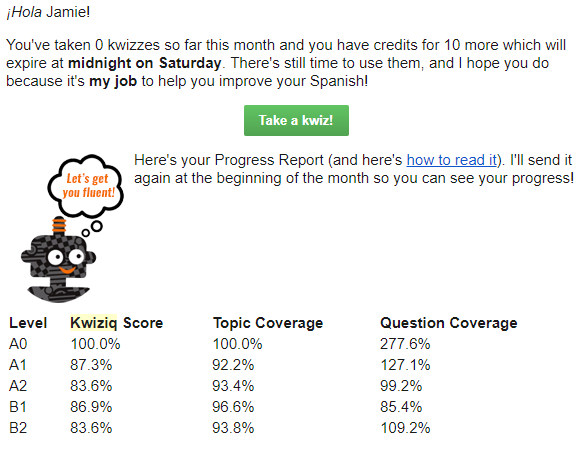
Kwiziq offers 10 free Kwizzes per month to everyone. I love this because the free content never expires! You can take free kwizzes as long as you want, they’re just limited. At the start of the new month, these 10 kwizzes are recharged.

This also means that you get your free kwizzes even if you were a member in the past but have since canceled, which is a thing that a lot of companies punish you for. If you cancel, you’ll still get an email once a month reminding you of free kwizzes that you have left, and when they’ll expire. Even if I’m not paying anymore, I still really like to be informed of free content that’s waiting for me.

Kwiziq review

Con: You can get a lot more for free elsewhere

Kwiziq isn’t the only guy out there with free quizzes to test your grammar fluency, but they’re the only one I know about that limits their quizzes. They are in competition with a couple of other resources that offer very similar products, with very similar information, all for free.

For example, Spanishdict is a great website with a free online Spanish-English dictionary, forum, and similar quizzes. These quizzes aren’t led by artificial intelligence, but they do a great job of providing you with the practice for some of these more difficult concepts.

Another popular free resource for grammar quizzes is StudySpanish. This website also has significant amounts of information available to help you understand your grammar, with some more hidden behind a paywall.

Note that both of these options are Spanish only. I’m not aware of similar resources for French as of this Kwiziq review.

Con: Kwiziq might be out of your budget

While Kwiziq is far from the only monthly membership platform to learn a language, it is on the pricey side. I do think the value is absolutely worth the price if you can swing it, and you specifically need to improve your grammar.

You can click here for Spanish pricing, and here for French pricing.

But don’t leave this Kwiziq review yet, there are still important features to talk about!

Pro: Kwiziq is more than just grammar

Primarily, Kwiziq is perfect for improving your Spanish and French grammar, but the other exercises in the “library” are excellent as well.

Just like Kwiziq’s grammar content, the exercises are also organized by A1-C2, so you get a really solid, in-depth understanding of your skill levels across the board, considering all 4 are rarely in the same place at any given time. And, honestly, I highly recommend Kwiziq for all language learners, if even just for these exercises.

In those practices (especially the last one), I love that it has you grade yourself. This is more flexible than the normal kwizzes, so you don’t have to mark yourself wrong for not seeing a word if you don’t find that necessary.

Then, of course, Kwiziq then links you to the individual lessons used in the statement, so you can figure out what you did wrong. If you’re not up to doing that research just yet, the icons to the right of the lesson links let you save them for later.

Still not quite getting it? All users are able to comment on the lessons and ask their questions, and Kwiziq’s Spanish teachers are actually incredibly responsive; if you’ve found something ambiguous and your question helps them see that something is confusing, they also have the power to make changes.

Plus, you can’t forget about the Weekend Workout! Every weekend, members get brand-new writing and listening challenges appropriate for every level sent directly to their email. It’s honestly a really nice reminder to keep up your practice, even if it’s only a little bit.

Kwiziq review: how to know if it’s the language app for you

At the end of the day, this Kwiziq review shows us a really great resource for French and Spanish learners. It has every grammar concept under the sun, and more are being added regularly.

Its gamification and easy-to-swallow kwizzes are addictive, which means that you’ll learn more grammar than you ever would anyways (let’s be real, most of us hate learning grammar). The exercises that are updated regularly are also a major win, I think.

If you’re not looking for grammar help, Kwiziq’s price point may not be worth it for you, depending on how much you use the other exercises. If you’re looking for something similar at a lower price point, I would recommend Yabla instead – not as pretty or user-friendly, but has similar types of exercises.

After reading this Kwiziq review, I would recommend all Spanish and French language learners, no matter the level, at least go through a few free kwizzes (click here for Spanish, or click here for French) and have the AI assess your level.

Filed Under: $101-200, $16-20, Advanced, Annual subscription, Audiobooks & video, Beginner, Communication, Daily streaks, Device, Explicit, Free, French, Gamification, Grammar, Implicit, Intermediate, Language app reviews, Language Skill, Level, Listening, Monthly subscription, Other Features, Pricing type, Reading, Spanish, Spelling, Stories, Target Language, Website, Words/phrases, Writing

italki review: the best place for private language lessons

March 21, 2022 by Jamie Leave a Comment

Italki is arguably the most popular language-learning resource online used by learners of all languages under the sun, so an italki review only seems reasonable! Like Verbling, italki provides its users the opportunity to practice speaking the language they’re learning with real live native speakers, regardless of geography.

From a social network for language learners in 2006 to the world’s most popular platform to find foreign language teachers, let’s dive into this italki review and see what the italki experience is like.

Finding your italki teacher

Italki boasts hosting native speakers of any and all languages you could be learning. Because there are so many italki teachers available to you, the site helps you narrow down your search, so you’re not sifting through all kinds of italki teachers that you don’t actually have any interest or need in setting up a conversation with.

That being said, your italki teacher search can and should be incredibly specific if you can make those decisions for yourself. This will really narrow down the number of choices you have to make.

So, for example, when I’m searching for an italki teacher to practice Spanish with, I’ll always choose Spain in this first category. Most of my experience communicating in Spanish is from living in Spain, so I have a hard time understanding accents from any other countries.

Though you do have a plethora of options to narrow down your search, my personal sticking point is that you can’t easily search by gender.

italki price

Hopefully, you’ll notice that one of those categories is “price”. Your italki price depends entirely upon the teacher that you choose. If, for example, you’re searching around for italki Spanish lessons, and you choose an italki tutor that’s from Spain (like I do), your italki cost is going to be just a bit pricier than if you’re learning from someone based in a Latin American country.

This is also the difference between an italki community tutor and professional teachers – because professional teachers are more experienced and likely have some sort of degrees or certification, you’ll pay a premium.

Fortunately, if you’re just testing the water, you do have 3 free trials to spend. Free trials are 30-minute lessons that must be used with different teachers. Not all teachers offer these trial lessons, but it makes it just a bit easier to try out using italki for the first time.

Choosing your italki teacher

After you’ve narrowed your search for an italki teacher, it’s time to do some deeper research. Each italki teacher offers a ton of information: an intro video, About Me, calendar, statistics, reviews, any packages they offer (like specific test prep, for example), and more.

Suffice it to say, all the information any reasonable language learner would need to make an educated decision.

And if you have any further questions, you can easily send your potential teacher an email, no pressure.

The italki lesson experience

Once you’ve gone through all these options and decided who you want to try out, you’ll go through a few steps. The italki platform does this all pretty well and very smoothly, in my opinion. Everything is very clear and to the point.

As you can see above, you’re already given a preview of your italki teacher’s availability on their page. And yes, this availability is presented in your time zone, so you don’t have to do any gymnastics to find a teacher that matches up with your schedule.

Once you’ve made an actual decision regarding who you want to learn from, you’ll get access to their calendar and be able to make a selection based on their open slots. If you’ve opted for a trial lesson, you’ll be able to select a 30-minute slot, and if you’re making a request within 24 hours, you won’t be able to cancel or reschedule your lesson after your teacher accepts it.

Then, once you choose a time, you’ll be able to choose your communication tool. Italki offers 3 options for you to host your lesson:

  • italki Classroom
  • Zoom
  • Skype

If you choose the italki Classroom (which I honestly recommend* – it runs well, and you don’t have to worry about tech issues/passwords), you’ll be granted access once your teacher accepts your lesson.

*it is worth noting that my experience using the italki Classroom is limited, and my teacher stated the platform isn’t as good as just using Skype or Zoom.

Then, like any lesson with a language teacher, you’ll be able to make full use of whichever platform you choose – talk to your teacher via the video chat, get corrections in the chatbox, or follow along if your teacher shares their screen to walk you through an activity.

italki language partner & other perks

Besides being able to pay to talk to native speakers of the language you’re learning, italki has also expanded to offer a few other perks. If you head to the Community tab on the upper right-hand side, you’ll see your options.

Articles are written by italki tutors, and you can specify which language you want to be reading in. Notebooks, on the other hand, are written by your fellow language learners, and you have the opportunity to both review others’ content and post your own practice and potentially have it reviewed by someone else.

You can see the option to listen to a recording, participate in a quiz, and answer a question, all of which can be great ways to engage in your target language.

italki review: group classes

Usually language learners seek out italki for private lessons, but some learners can try out italki’s group classes as well. It’s not nearly as popular on this platform, so you’ll have fewer options, but it’s still an opportunity you may want to take advantage of.

As of the date on the bottom of this post, group classes are only an option for learners of English, Spanish, and Japanese. To be honest, though, I’d be more inclined to use Lingoda for group English and Spanish lessons, as that’s Lingoda’s bread and butter.

But if you’re more interested in one-off group lessons, every bit of exposure to the language helps.

italki review: alternatives

If this italki review just proves that you’re looking for something else, there are also a few italki alternatives you might also consider. There aren’t many other major platforms like italki, especially considering the sheer number of languages available.

For websites like italki that also host a variety of languages, you might consider Verbling, which is very closely related – the biggest difference is that Verbling does not support as many languages. HelloTalk is a free option if finding a professional teacher isn’t important to you.

And if you’re looking for one language in particular, that may help narrow down your search. BaseLang, for example, is a potential option for Spanish language learners who are open to a more intensive commitment..

italki review: in conclusion

This italki review proves that the platform has a lot to offer any language learner. There’s a reason it’s the go-to for most of us in the language learning community. Conversations with natives in almost any language you could think of are easy to find with just an internet connection; it doesn’t get much simpler than that!

Ready to give italki a try? Click here to get $10 in free italki credits!

Filed Under: Advanced, Afrikaans, Ainu, Albanian, American Sign Language, Amharic, Android app, Arabic, Aramaic, Armenian, Assamese, Azerbaijani, Basque, Beginner, Belarusian, Bengali, Bosnian, Breton, Bulgarian, Burmese, Cantonese, Catalan, Cebuano, Cherokee, Chibemba, Chichewa, Chinese (Hakka), Chinese (Mandarin), Communication, Community, Conversation, Conversation, Creole, Croatian, Czech, Danish, Dependent on Users, Device, Dutch, Dzongkha, English, Esperanto, Estonian, Explicit, Farsi, Feedback, Fijian, Finnish, Flemish, French, Gaelic, Galician, Georgian, German, Grammar, Greek, Greenlandic, Group, Guaraní, Gujarati, Hakka, Hausa, Hawaiian, Hebrew, Hindi, Hokkien, Hungarian, Icelandic, Igbo, Ilocano, Implicit, Indonesian, Intermediate, iOS app, Irish, Italian, Japanese, Javanese, Kachchi, Kannada, Kazakh, Khmer, Kinyarwanda, Korean, Kurdish, Kyrgyz, Language app reviews, Language Skill, Latin, Latvian, Level, Listening, Lithuanian, Macedonian, Malagasy, Malay, Malayalam, Maltese, Manx, Maori, Marathi, Mongolian, Navajo, Neapolitan, Nepali, Norwegian, Occitan, Ojibwe, Oriya, Oromo, Other Features, Papiamentu, Pashto, Persian, Pidgin (Nigerian), Piedmontese, Polish, Portuguese, Potawatomi, Private, Professional, Punjabi, Romanian, Russian, Saami, Samoan, Sanskrit, Sardinian, Scots, Scottish Gaelic, Serbian, Shangainese, Shona, Sicilian, Sindhi, Sinhala, Slovak, Slovenian, Somali, Spanish, Speaking, Swahili, Swedish, Swiss German, Tagalog, Tamil, Target Language, Telugu, Thai, Tibetan, Tigrinya, Tok Pisin, Turkish, Tuvan, Twi, Ukrainian, Urdu, Uzbek, Vietnamese, Website, Welsh, Wenzhounese, Writing, Yiddish, Yoruba

Verbling review: don’t sleep on this language teacher platform!

March 21, 2022 by Jamie Leave a Comment

In the language learning community, there are two well-known and well-trusted ways to practice having conversations with native speakers: italki and Verbling. They have their similarities and differences (as noted in my Verbling vs italki review), but now let’s focus on this Verbling review.

In this Verbling review, I’ll take you step-by-step through going to the Verbling website for the first time, all the way through your first lesson, pros and cons, and alternatives to Verbling for all your language learning needs.

Verbling review: find a private language teacher

Starting from the “Find a Teacher” button right next to the italki logo, you’ll find yourself confronted with a huge list of people who teach your target language, as well as a few options to narrow down your search.

As you can see, Verbling keeps the search criteria pretty simple: language, location (important because you may be more confident with certain accents), any particular goals you have, and availability.

In the past, Verbling used to allow you to search by gender, which was a huge plus for me. They seem to have removed this option, though.

After applying your preferred search, click through to any of the Verbling teachers that stand out to you. And if none stand out to you, pick one at random! You can learn about any teacher you like, including listening to their voice/accent, and hopefully getting to know them a little bit before booking a lesson.

You’ll find tons of information on the Verbling teacher you chose, like their resume, how long they’ve been on Verbling, how many lessons their average students take with them, detailed reviews, any articles they’ve written, and more.

It can be a lot to take in, but you only need to take what’s most important to you. The idea is to give you an opportunity for an educated choice before you spend your time/money on your first lesson, even if you opt for a discounted trial lesson.

Once you make your choice, you’re just 2 clicks away from your first Verbling lesson. They don’t make it difficult, which is helpful. I definitely understand the pressure of hitting that “buy now” button, so I appreciate how easy it is to get started.

Once you complete your trial lesson (or even before), you can also opt for bulk lessons with that teacher at a slight discount. This is a plus not only for convenience but also for accountability – you’re more likely to consistently practice if you’ve already bought the lessons.

It’s worth noting that the discount you get with bulk lessons differs from teacher to teacher (and not all Verbling teachers offer lessons in bulk) so don’t make any assumptions based on this Verbling review. However, this is a feature unique to Verbling.

What Verbling classes are like

If you’ve never taken an online class with a private language tutor, you can expect your language teacher to start a conversation with you by asking some getting-to-know-you questions.

This will likely be primarily over video chat, with the added perk of using the chat box to help with spelling or vocabulary. If your Verbling teacher has an activity for you, they’ll probably share their screen, like any Zoom call you’ve been in.

However, Verbling language lessons do not occur over Zoom or even Skype – they use Verbling’s own proprietary software and that’s it. This does make things easy when it’s time for your lesson because all you have to do with click a button and be connected.

Then, once your lesson’s finished, Verbling will email you summarizing your lesson. This summary can help you keep a record of when/how often you’re practicing, with whom, the vocabulary you referenced, and your conversation. If you really like your teacher, you can also go ahead and book another lesson right from this summary.

The Verbling community

If you’ve got a few minutes to spare, you can also check out Verbling’s Community tab. You may be able to find an interesting article or a future Verbling teacher you may like, but it’s definitely not Verbling’s strongest suit.

Honestly, it seems more like a side project than a full-blown feature.

If your teacher referenced an article they wrote or a discussion thread they started, you can also click on the My Teachers tab and easily find any of the content they posted. Or, if you’re just browsing around the Trending tab, and you find an article that you’re interested in or have a question regarding, each article links to the teacher who posted it, so it’s easy to send them a message asking for clarification, or (better yet) book a lesson to chat about it in the language you’re learning.

This option is definitely helpful for coming up with material to talk about in your lessons, as your teacher will probably ask you what you want to talk about after you’ve had your initial “getting to know you” lesson.

It can be tough to come up with good material for yourself, especially when your new language teacher doesn’t know you well enough just yet to recommend study material that will be engaging to you. Think of this section as Verbling’s library.

Verbling review

While Verbling (now a part of Busuu/Chegg) isn’t as popular or well-rounded as italki, this Verbling review shows that it’s still a great option for language learners who want focused conversational practice with professional native speakers.

There are a few key differences, as noted in my italki vs Verbling comparison review, but the most significant thing to know is that the value and experience you get from either platform depends not on the platform itself, but on the teachers you work with.

My recommendation? If you are looking for conversational practice with professional, experienced native speakers, Verbling is an excellent place to start.

You can also look for non-professional native speakers (so basically a glorified Tandem or HelloTalk language exchange) on italki, but regardless of your choice, don’t be afraid to shop around for a private language teacher on Verbling!

Filed Under: Advanced, Afrikaans, Ainu, Albanian, American Sign Language, Amharic, Android app, Arabic, Aramaic, Armenian, Assamese, Azerbaijani, Basque, Beginner, Belarusian, Bengali, Bosnian, Breton, Bulgarian, Burmese, Cantonese, Catalan, Cebuano, Cherokee, Chibemba, Chichewa, Chinese (Hakka), Chinese (Mandarin), Conversation, Conversation, Creole, Croatian, Czech, Danish, Dependent on Users, Device, Dutch, Dzongkha, English, Esperanto, Estonian, Farsi, Feedback, Fijian, Finnish, Flemish, French, Gaelic, Galician, Georgian, German, Greek, Greenlandic, Guaraní, Gujarati, Hakka, Hausa, Hawaiian, Hebrew, Hindi, Hokkien, Hungarian, Icelandic, Igbo, Ilocano, Indonesian, Intermediate, iOS app, Irish, Italian, Japanese, Javanese, Kachchi, Kannada, Kazakh, Khmer, Kinyarwanda, Korean, Kurdish, Kyrgyz, Language app reviews, Language Skill, Latin, Latvian, Level, Listening, Lithuanian, Macedonian, Malagasy, Malay, Malayalam, Maltese, Manx, Maori, Marathi, Mongolian, Navajo, Neapolitan, Nepali, Norwegian, Occitan, Ojibwe, Oriya, Oromo, Other Features, Papiamentu, Pashto, Persian, Pidgin (Nigerian), Piedmontese, Polish, Portuguese, Potawatomi, Private, Professional, Punjabi, Reading, Romanian, Russian, Saami, Samoan, Sanskrit, Sardinian, Scots, Scottish Gaelic, Serbian, Shangainese, Shona, Sicilian, Sindhi, Sinhala, Slovak, Slovenian, Somali, Spanish, Speaking, Stories, Swahili, Swedish, Swiss German, Tagalog, Tamil, Target Language, Telugu, Thai, Tibetan, Tigrinya, Tok Pisin, Turkish, Tuvan, Twi, Ukrainian, Urdu, Uzbek, Vietnamese, Website, Welsh, Wenzhounese, Yiddish, Yoruba

Busuu review: the best combo of academic & social

March 21, 2022 by Jamie 1 Comment

Busuu is one of the most popular, recognized, and biggest language apps out there (so much so that they bought out Verbling, and are now owned by Chegg, a huge education company), and in this Busuu review, it will be made clear why it’s so well-liked. Get to know all of Busuu’s features and how to best use them for your own language learning so you can reach your language goals faster.

If after this Busuu review you find that it’s not the best solution for your language learning, I’ll also share some alternatives based on Busuu’s flaws so you can make the best choice for your languaeg learning.

Busuu review: languages offered

Busuu is available to learners of the most common foreign languages:

  • Arabic
  • Chinese
  • English
  • French
  • German
  • Italian
  • Japanese
  • Polish
  • Portuguese
  • Russian
  • Spanish
  • Turkish

Busuu is appropriate for all levels of these languages, making it accessible for language learners coming from all over. This is important because some of Busuu’s features are only successful because of its huge audience.

Without further ado, let’s take a look at Busuu and see if it’s the language app for you.

Busuu review: quality of lessons

Thanks to Busuu’s partnership with Chegg (a college education company), you can rely on Busuu for a high-quality education based on the CEFR levels (or Fluency Score, as they put it). Right from the start, this sets our expectations: Busuu is focused on academic use of the language, i.e. passing exams and textbook knowledge.

While many of us language learners have been taught that this is the only and/or best approach to learning languages, but it quite simply is not (always). If your goal is not an academic one, and you instead want to focus on being conversational as a priority…well, we’ll talk about this lower down in this Busuu review.

With this in mind, let’s take a look at Busuu’s first lesson to see how they execute their academic approach.

If you’re not a total beginner in the language, you have the option to take Busuu’s assessment. As a general rule, I take these online language level assessments with a grain of salt; no matter the platform, they’re almost always some variation of inaccurate. I recommend you do the same.

From the start, it’s clear that I was right about Busuu’s approach to learning a language! Very academic, very focused on using the language “correctly” and working towards the eventual goal of taking and passing an assessment.

Busuu’s assessment basically judges my ability in Spanish based on grammar, and much less so on things like communication or understanding. As such, I was really frustrated to be put at the A2 level in Spanish. I understand why – my A2 grammar is top-notch, and my intermediate is fairly functional but not quite textbook – but A2 is much too conservative, and I know that the content will be too easy.

It doesn’t seem like this would be too big of a deal, but in the past (and in the present for many language learners) I’ve followed these assessments, learned what they’ve told me to learn, and then quickly gotten bored and given up because of it.

After completing the assessment, you’re sent off to a comprehension lesson based on where Busuu thinks your level is. And keep watching, because I was genuinely shocked at the end to see some gamification.

As I assumed, the A2 level was boring and repetitive for me. The vocabulary was snooze-worthy, and I was not even the least bit challenged. This isn’t as much of a problem for me because I know how to solve the problem, but it can prove to be an insurmountable obstacle for language learners who are used to being bored and use this as further proof that they don’t like/are not good at learning languages.

Fortunately, Busuu allows you to switch lessons and attempt checkpoints at any time! You have to achieve at least 80% in this checkpoint, and the questions are pretty well-rounded. They prioritize grammar, of course, but also include other ways to use the language.

Regardless, I do really like the lessons themselves (once I get to my appropriate level!). Everything is very smooth and user-friendly, and the video comprehension questions make the language just a touch more 3-dimensional, too. I can tell that they’re trying to make a traditionally boring skill just a bit more engaging.

And like any intentional journey to learn a language, Busuu lessons end with a certificate! Unfortunately, official institutions will not accept a McGraw-Hill (another textbook company!) certificate from Busuu as proof of foreign language fluency.

You can use it as a resume builder for unrelated career paths, or you can frame it for your own personal pride, but it’s not the same as an official CEFR exam.

This certificate is also only available to paid users (which we’ll talk about more in a second).

Vocab review

Need to review? Busuu has a sleek way to have you review the vocabulary terms you come across in the lessons. The platform itself looks great, and I appreciate how you not only have to spell the words, but you also will be marked wrong if you don’t use appropriate accents, but there’s room for growth.

For one, I wish I could tell Busuu that I already know these terms. If I continued on with more at-level vocabulary, it would be easier to kick these easier terms out and focus on what would actually be helpful for me. I don’t see that option anywhere, though.

I do also wish you could add your own vocab! Assuming you’re using more than just Busuu to learn a language, or that you’re not a total beginner, it would be helpful to include other terms that you find off-platform. Spanishdict is an excellent example of this improvement.

Honestly, the fact that you can’t give Busuu any input whatsoever is a major bummer. These words are super easy for me (I told you I wasn’t A2!), and if I follow this lead, I’ll just be studying these terms that I already know until my eyes bleed.

Busuu community

Besides the frankly awesome lesson pathway, Busuu really excels with their community! You can only get so far in your language learning without actively using the language and making any kind of connections; fortunately, Busuu’s got you covered.

Click over to the “Community” tab to participate.

Here you have the opportunity to make connections with other language learners who can benefit from your native skills (hello, potential language exchanges!), as well as to practice your own use of the language in whichever way you see fit.

If your priority is communication, focus on the different ways to practice speaking. Likewise with written skills.

Whichever method of communication you want to improve, your response will be automatically submitted to the community, where native speakers can help correct you and encourage you along the way, just like you can encourage those practicing and learning your native language.

Wait a beat, check your notifications, and you’ll get a handful of corrections from the native-speaking community.

If you like, you can also go through and add respondents as friends and form a mutually-beneficial relationship where you correct each other’s submissions.

Finally, you can see all your corrections, submissions, and potential language friends by visiting your profile.

Busuu’s community may not be their primary talking point, but do yourself a favor and keep it in mind when you consider using Busuu to learn a new language! Even if this isn’t the only version of an online community for language learners, I think it blows communities like HelloTalk out of the water completely.

The difference between Busuu Premium and free

The bulk of Busuu is available for free to all, which is amazing! It’s awesome to see such a high-quality resource accessible to language learners of all different economic backgrounds. If you opt for Busuu Premium, you can also access:

  • No ads
  • Additional “fun” courses (travel, pronunciation, etc.)
  • AI-powered vocab review
  • Faster community feedback
  • The aforementioned Busuu certificates

These features are all not required for basic learning of the language. If you find them beneficial to your language learning and believe they would help keep you motivated, you’ll be happy to know that Busuu Premium is also very reasonably priced!

You can also start out with a 14-day free trial before you commit.

Click here to see updated pricing.

Busuu review: worth the hype for you?

Busuu’s success isn’t a mystery – it combines the academic approach to learning a language with a more motivating platform (meaning modern technology, not boring textbooks) and a strong community of other language learners to help keep you and your language learning on track.

If this sounds like your kind of language app, you can click here to get started with a free trial of Busuu Premium.

However, if grammar is not high on your list of priorities, you may find Busuu boring. If, for example, you want a stronger focus on conversational skills, you might consider finding a tutor on Verbling (which is owned by Busuu, fun fact!)

Or, if you like the structured, step-by-step approach to mastering a language but don’t want to rely so heavily on grammar, LingoDeer may be another option for you to consider.

Filed Under: $10-15, $50-100, Advanced, Android app, Annual subscription, Arabic, Beginner, Chinese (Mandarin), Communication, Community, Conversation, Curated flashcards, Daily streaks, Device, English, Explicit, Feedback, Free, French, Gamification, German, Grammar, Intermediate, iOS app, Italian, Japanese, Language app reviews, Language Skill, Level, Listening, Monthly subscription, Notifications, Other Features, Polish, Portuguese, Pricing type, Prompts, Reading, Russian, Spanish, Speaking, Spelling, Target Language, Turkish, Vocabulary, Website, Words/phrases, Words/phrases, Writing

Glossika review: for all your repetition needs

February 6, 2022 by Jamie Leave a Comment

Glossika is a highly engaging way to learn 60+ different languages. It does this with AI-supplemented sentences, high-quality audio, and a variety of different types of exercises. In this Glossika review, let’s take a walkthrough of the platform and discuss who can benefit most and who won’t.

And if Glossika doesn’t look like your kind of language app, keep scrolling to see some Glossika alternatives.

Glossika review: available languages

As mentioned, Glossika offers courses in 60+ languages:

  • Arabic (Egypt)
  • Arabic (Morocco)
  • Arabic (Standard)
  • Armenian (Eastern)
  • Azerbaijani
  • Belarusian
  • Bengali (India)
  • Bulgarian
  • Cantonese (HK)
  • Catalan
  • Chinese (Mandarin)(Beijing)
  • Chinese (Mandarin)(Taiwan)
  • Croatian (Štokavian)
  • Czech
  • Danish
  • Dutch
  • English (British)
  • Estonian
  • Filipino (Tagalog)
  • Finnish (SW dialect)
  • French
  • Gaelic
  • Georgian
  • German
  • Greek
  • Hakka (Hailu)
  • Hakka (Sixian)
  • Hebrew
  • Hindi
  • Hokkien
  • Hungarian
  • Icelandic
  • Indonesian
  • Irish
  • Italian
  • Japanese
  • Kazakh
  • Korean
  • Kurdish (Sorani)
  • Latvian
  • Lithuanian
  • Manx
  • Mongolian
  • Norwegian (Nynorsk)
  • Persian
  • Polish
  • Portuguese (Brazilian)
  • Portuguese (European)
  • Russian
  • Serbian (Ekavian)
  • Slovak
  • Slovenian
  • Spanish (Mexican)
  • Spanish (Castilian)
  • Swahili
  • Swedish
  • Thai
  • Turkish
  • Ukrainian
  • Uzbek
  • Vietnamese (Northern)
  • Vietnamese (Southern)
  • Welsh
  • Wenzhounese

And because Glossika cares about language preservation, a few of them are available for free; you don’t get all the benefits of a paid membership, but you do get unlimited spaced repetition practice to do your part to keep these languages alive.

We’ll talk about that more at the end.

Glossika review: the placement test

To start with Glossika, you can first opt to take a placement test. It’s a very simple test: listen to a few audio recordings of sentences, and select the sentence that you hear. If it ever gets too hard, you can always let Glossika know that you need to start from that level.

Unfortunately, like most placement tests, it’s pretty useless.

While the audio recordings themselves are very clear and high quality (the same goes for the usability of Glossika as a whole), I’d rather they just toss the whole thing.

The sentences are so different that all you need to do is recognize one single word at the beginning to answer correctly. This is regardless of whether you understood the statement itself or could even create it – you can see towards the end of the above video that I could answer correctly based on literally the first word.

And that’s beside the fact that it’s only testing listening (despite claiming to exercise all the language skills) and didn’t even attempt to test me beyond B2. Where the placement test is concerned, I’d rather they just ask me directly.

Glossika review: learning new phrases

Glossika teaches users a new language by introducing new sentences that are useful in day-to-day life. You’ll learn to understand the language implicitly, as opposed to learning new vocabulary words and grammatical terms piece by piece.

You’ll learn 5 phrases like this at a time, through reading, writing, listening, and speaking, as well as using spaced repetition.

Glossika lessons follow this format:

  1. The new phrase is presented written in both your source and target language
  2. You hear a recording of the phrase in both languages, so you can follow along
  3. You type out the phrase in the foreign language
  4. You reread the phrase just in the foreign language
  5. You record yourself saying the phrase in the foreign language

As you can see, you got these phrases drilled into your brain really well. It doesn’t seem to be wildly sensitive to mistakes (I didn’t use any capital letters or accents, for example) which can be a significant drawback if you don’t get used to spelling appropriately, especially with Spanish.

Glossika is very customizable, which is a plus; for example, you can opt out of speaking practice if it’s not convenient for you at the moment, or you can turn the English translation on or off. The only problem is that these customizations aren’t obvious.

Another example: this next video was actually my first attempt at a lesson with Glossika.

I didn’t realize that it had automatically been set to “listening mode” until I started clicking around. There’s no tutorial showing you these options, nor any attempt to even let you know they’re there, so you’ll have to do some experimenting for yourself.

Maybe there’s an option to require correct accents somewhere? If there is, it’s not obvious.

Another helpful setting that Glossika didn’t tell me: if any of the phrases are too easy for you, just click the smiley face, and they’ll be taken out of the cycle.

Nonetheless, if used appropriately, this approach can provide language learners with a very well-rounded language education.

As a whole, I do love Glossika’s approach! In general, it’s engaging, modern, and really attractive.

Glossika’s “reps”

If you hang around Glossika’s Facebook group enough, you’ll see tons of talk about “reps”. The basic idea is that Glossika teaches through repetition, and your mastery of any given phrase or sentence can be defined by how many reps you’ve completed.

With Glossika’s approach, if you repeat their sentences enough times, you’ll master the language! How many times? According to this page here:

  25,000 Reps → Speak sentences comfortably
  50,000 Reps → Start engaging in casual conversations at natural speeds
  75,000 Reps → Start honing skills with more specialized topics
100,000 Reps → Mastery level where you can say just about anything

This is Glossika’s version of spaced repetition (also known as SRS). This concept is not unique to Glossika; it’s when a computer program predicts how easy or difficult any given term or phrase is for you. If it’s easy, and you get it correct, it puts that term to the side until it thinks you’re just about to forget it. Then it shows you that phrase again, therefore getting that phrase from your short-term to long-term memory.

Does this make sense? Sure. Using this strategy, could you theoretically boil down a language to a specific number [of repetitions]? Makes sense.

The problem is (and this is my personal opinion), repeating the same phrases tens of thousands of times is insanely boring.

You’ll practice each phrase 5 times at a minimum, more often if you’re struggling with it. This strategy is great for the more logical and scientific of minds, less so for those needing more entertainment.

Don’t get me wrong, repetition is very important for every language learner. But for my own personal needs, this level of repetition drives me crazy.

Using your stats

Glossika is very scientifically-lead, so their stats are a bit more interesting than most. For one, I love this feature of the “Memory” tab.

Note: I don’t know if the audio problems are because of my device, or a Glossika error.

As I was doing my spoken reps, I honestly didn’t realize that my audio was actually being recorded, so I was disappointed at first. However, going back into this section I can listen to myself repeating the phrase, and compare it to Glossika’s native audio.

This is a helpful strategy called “shadowing”, where you learn to mirror your pronunciation of a foreign language based on an audio clip. Honestly, it’s pretty tough to come by, which is strange considering it’s a simple way for any given language learning app to help you practice speaking a foreign language.

Another interesting feature: you can choose the topics of Glossika’s sentences.

I appreciate being able to tell Glossika that I have absolutely no interest in talking about the military or science. It’s not quite enough to make the approach less boring (again, as a personal opinion and not at all an objective one), but every little option that users can mess with is a bonus.

Glossika’s pricing

Glossika offers free trials to all new users, and then offers 2 pricing tiers: $30/month for unlimited reps in unlimited languages, and about half that per month to only change your language once every 30 days.

This new lower tier is brand new as of this Glossika review, and I’m very happy to see the compromise to make language learning more accessible!

And finally, in an effort to promote minority languages, the following languages are 100% free to all users:

  • Catalan
  • Gaelic
  • Hakka (Sixian)
  • Hakka (Hailu)
  • Kurdish (Sorani)
  • Manx
  • Welsh
  • Taiwanese
  • Wenzhounese

If going through this Glossika review convinces you to give it a try (more on that below), I highly recommend you at least spring for your free trial. No credit card is required!

Glossika review: who it’s for

Glossika is beautiful, smooth, and high quality, but it’s not for everyone. For one, Glossika does not start from 0, with basic vocabulary and grammar. Instead, you’ll start with beginner phrases. It’s more of the “figure it out as you go” approach, as opposed to the “1+1=2” one.

If you’re a big fan of repetition, Glossika is great for a wide variety of language learners, especially how well they tackle all the language skills. The advanced customization is a huge plus, too, as long as you’re tech-savvy enough to figure it out for yourself.

But if you want usability with a less…sterile approach, you’re not alone. If that’s the case, I might recommend Busuu, which connects the language more by way of living, breathing community, as well as more explicit language lessons.

Hooked on Glossika and want to give it a try? Click here to start your free trial!

Filed Under: $101-200, $16-20, $201-300, $21-30, Advanced, Android app, Annual subscription, Arabic, Armenian, Azerbaijani, Belarusian, Bengali, Bulgarian, Cantonese, Catalan, Chinese (Mandarin), Chinese (Mandarin), Croatian, Czech, Danish, Device, Dutch, English, Estonian, Finnish, French, French, Gaelic, Georgian, German, Greek, Hakka, Hebrew, Hindi, Hokkien, Hungarian, Icelandic, Indonesian, Intermediate, iOS app, Irish, Italian, Japanese, Kazakh, Korean, Kurdish, Language app reviews, Language Skill, Latvian, Level, Listening, Lithuanian, Manx, Mongolian, Monthly subscription, Non-English base language, Norwegian, Offline use, Other Features, Persian, Polish, Portuguese, Pricing type, Russian, Russian, Serbian, Shadowing, Slovak, Slovenian, Spanish, Speaking, Spelling, Swahili, Swedish, Tagalog, Target Language, Thai, Turkish, Ukrainian, Uzbek, Vietnamese, Website, Welsh, Wenzhounese, Words/phrases, Writing

  • « Go to Previous Page
  • Page 1
  • Page 2
  • Page 3
  • Page 4
  • Interim pages omitted …
  • Page 6
  • Go to Next Page »

Primary Sidebar

Meet your language coach

Hi! I'm Jamie (she/her), and I help you learn exactly what you need to do to learn a foreign language. Click my face above to learn more about me and how I can help.


We strive to offer equitable access to language learning for all, regardless of ethnicity, gender identity, ability, or sexual orientation.
Copyright © 2025 · Multilingual Mastery · Privacy Policy

  • About
  • Get 1:1 support
  • App search