• Skip to primary navigation
  • Skip to main content
  • Skip to primary sidebar
Multilingual Mastery

Multilingual Mastery

Online language learning coaching & education

  • About
  • Get 1:1 support
  • App search

Stories

StoryLearning review: lazy, but you’ll learn to read

October 6, 2023 by Jamie 18 Comments

StoryLearning is a well-known language learning course developed by polyglot Olly Richards, and its approach is pretty self-explanatory: learn a language through story. The internet is chock full of five-star reviews, but is the heavy price tag worth it for you? In this StoryLearning review, that’s exactly what you’ll find out.

Keep reading this StoryLearning review to find out what these courses do, what they don’t do, and how to decide if you should give them a try.

Languages you can learn with StoryLearning

While not all languages are created equal (as in, some offer more content than others), you can use StoryLearning to learn:

  • Arabic
  • Chinese (Mandarin)
  • Danish
  • French
  • German
  • Italian
  • Japanese
  • Korean
  • Latin
  • Norwegian
  • Portuguese
  • Russian
  • Spanish
  • Swedish
  • Turkish

Now let’s dive into the course itself.

StoryLearning review: course structure

As you log in to your StoryLearning course for the first time, you’ll have several pages introducing you to the course, including an introduction to your language teacher (Olly does not teach the languages himself, he just hosts a platform for others to teach using his methodology) and the basic gist of what makes StoryLearning special.

Here’s a clip.

You’ll also learn more details about how you will be learning a language through story. Specifically, each chapter corresponds with a chapter of a story created just for StoryLearning. They’re all broken up into the following lessons:

  • Read and listen to the chapter of the story
  • Learn the cognates (words that sound similar and mean the same in English [not to be confused with false friends, which sound similar but mean very different things]) present in the chapter
  • Break down vocabulary words deemed important
  • Learn the basic grammar used
  • Simple pronunciation lesson
  • Cultural tidbit
  • A speaking lesson meant for you to share with a language teacher and/or language exchange partner

Then you’ll move on to the next chapter and do it all over again until you finish the story.

The idea is that if you’re consistent, you’ll understand more and more of the language until you finish the story and have successfully reached a certain level within said language.

All that said, let’s check out a StoryLearning lesson.

Chapter

The basis of every chapter of the StoryLearning courses is the chapters of the book. Here’s what that looks like.

As you can see, there’s even more explanation about how the course works before the first actual lesson.

  1. Listen to the audio recording a few times
  2. Read the foreign language translation a few times while listening to the audio recording
  3. Read the English translation to see how much you understood correctly

It goes on to explain (again) how to use the course; basically, be ready to repeat the same section over and over and over again, and understand little to none of it. It’s all part of the process, and it’ll work if you can stick to it.

Repetition, repetition, repetition – it’s like Pimsleur in this way, except you understand what’s going on in Pimsleur’s lessons. Here, you’re specifically meant to understand very little.

Cognates

Now that we have the sounds of the chapter in our brains, and maybe we’ve even made some connections between words ourselves, it’s time to acknowledge cognates.

This is a fairly common practice across some language learning resources, like Language Transfer. Anything to make it easier to connect to languages that are very different from your native language!

At this point, you should be starting to make sense of the language. It’s kind of like the first lesson is trying to get your brain to understand it by purely brute force, and then the following lessons give you a little step up solidifying the meaning behind these new sounds.

So now that we’re understanding a bit more of the general meaning behind the chapter, let’s learn some vocab.

Vocabulary

Even for such a short chapter, a total beginner of the language is not going to know any of the vocab presented. You might be curious as to which vocab words the teacher things are the most important to be explicitly taught. Most strategies go:

words > sentences > story

but this one seems to go:

story > words

Here’s what I mean.

Out of all the words I don’t understand in the chapter (which is all of them, for the record), these are the ones chosen to study specifically. It’s so weird to be learning “yes” and “no” after drilling the chapter of a story!

Then we have the practice. It’s a simple Quizlet plugin, where the words have been uploaded to the Quizlet platform and the link is copied and pasted into the course.

You’ll drill some chosen vocabulary by:

  • matching (as shown in the video above)
  • test (try to get the right answer)
  • spelling
  • flashcards

Can I be honest here?

This is lazy.

For such a well-known, expensive language course, I would expect more from the vocabulary section. I can’t even get it to work! Given that it is a Quizlet plugin, I would literally rather be given the vocab words in a list and put them into my own Quizlet account, or another flashcard system.

Using the StoryLearning approach, you’re not supposed to be memorizing lists of words, which is fine. If that’s the case, why include a vocab section at all?

Next is grammar, which is also not meant to be studied like a textbook, but instead picked up naturally.

Grammar

Olly is very clear that the StoryLearning approach is not your boring, basic textbook approach to a language, which is generally very focused on grammar. So, let’s see how they do it.

In this section, the specific concepts seem a lot less random.

While the strategy is the exact same one used in the previous lesson on vocabulary, the key difference here is that grammar is basically the patterns of the language. I like how the words can be pulled out of the chapter as examples of the beginner grammar pattern, which creates context and makes it much easier to learn.

It didn’t work this well for vocab, which felt like random words that were *chosen*.

However, the Quizlet activity is exactly the same. This is frustrating to me because I know there are much better options for practicing grammar! Again, I would rather be directed to high-quality grammar activities than this.

Next up: pronunciation.

Pronunciation

I’m curious about this section because most language learners don’t worry about pronunciation. Perfect pronunciation doesn’t tend to be a priority.

I approve!

Most language learners don’t realize that improving your pronunciation also improves your ability to understand a foreign language because you’re tuning your ear to understand the sounds that are used by native speakers.

StoryLearning is largely about input (understanding the language, not as much producing it yourself), and simple pronunciation lessons like this one are really helpful for listening comprehension.

The next lesson, culture, is another topic that isn’t always considered to be important.

Culture

Personally, I love culture. It tends to be one of my favorite parts of learning languages! Not always because of how it helps me to understand and use a language correctly, but just because I find it interesting.

Here’s how StoryLearning connects culture to language learning.

I’m going to be brutally honest again.

This StoryLearning review has proven this course to be dynamic, with videos, audio lessons, and activities to practice the concepts. So why is the lesson on culture…not?

Especially with the specific phrases used to explain the concept, they would be 10x more interesting and engaging with simple audio clips of the teacher saying the words and phrases. It would also really help with listening comprehension and being able to contextualize the lesson.

Time for the last section of each chapter.

Speaking

Speaking is not a big priority in the StoryLearning courses. The priority is reading, maybe listening to, stories meant for language learners. So I was surprised to find a speaking section in every chapter. Here’s what that looks like.

Once again…I’d rather they stick to what they’re good at.

This isn’t speaking practice as much as it is a free lesson to give to a language teacher or language exchange partner if you’re working with one. It is a good way to connect other language learning to what you’re learning with StoryLearning, but it’s not particularly effective by itself.

So once again, I would be more impressed if they stuck with what they’re good at – stories, reading, and listening comprehension – and leave all the other stuff to other resources that are much better at them.

I’d bet good money that at least 50% of all their students are just skipping right past the speaking section, finishing their StoryLearning courses, and then being frustrated that they can’t hold a conversation.

StoryLearning review: community

As you work through the StoryLearning courses, it’s suggested you join the private student community. Like, on every page. Each language has its own community. Here’s what it’s like inside.

As you can see, each language is broken up into the following categories:

  • Say hello
  • The level(s) you’ve purchased
  • Live coaching
  • Fun & motivational stuff

But, really, it just appears to be a timeline of unanswered tech issues.

One more time: stick to what you’re good at!

Judging by the rest of the StoryLearning course, the team is perfectly good at recording lessons and putting them where they belong, but not so much at keeping things updated and engaging in conversation.

That said, is the private student community a bonus to the StoryLearning courses? I’m honestly not sure.

StoryLearning review: price

For lifetime access to any one of the StoryLearning “Uncovered” courses, you’ll pay $297. This makes these courses one of the more expensive options on the market.

That’s really all there is to say about that. They’re commonly on special sales, or at least said to be on sale, but they’re pricey regardless.

Fortunately, you can get a 7-day free trial before you commit.

StoryLearning review: is it for you?

In this StoryLearning review, I’ve been more critical than most. A big reason for this is that those who are most excited about these courses are Olly’s personal friends, which makes their reviews far from objective.

So how do you know if StoryLearning is the right approach for you to learn a language?

First: reading has to be a priority. Listening too, but mostly reading. The point is to learn a language by reading stories, so if your goal isn’t to be able to read books in your target language, you’re better off using another method.

Second: either speaking the language isn’t important to you, or you’re getting your speaking practice elsewhere, whether that be with a language teacher or a language exchange. While there is technically a section for speaking practice, it does not suffice for those who really want to be conversational.

And third: you’re patient. While StoryLearning will teach you the language, you basically have to be willing and able to trust that it’s going to happen without being able to see a lot of the progress for yourself. Now this is normal for intermediate and advanced language learners, but true beginners are likely to give up before it really pays off.

In fact, you should probably meet all 3 conditions to benefit from any of Olly Richards’ resources, even his line of Short Stories books. 

If you don’t, I would recommend another language learning resource that’s more geared toward teaching the skills that matter most to you, and that’s why I created my language app search. 

But if you do, give StoryLearning a shot with a 7-day free trial here!
Filed Under: $100-299, Arabic, Audiobooks & video, Beginner, Chinese (Mandarin), Danish, Device, Explicit, French, German, Grammar, Intermediate, Italian, Japanese, Korean, Language app reviews, Language Skill, Latin, Level, Listening, Norwegian, One-time purchase, Portuguese, Pricing type, Reading, Russian, Spanish, Stories, Swedish, Target Language, Turkish, Website

Kwiziq review: fun AND quality grammar lessons

March 21, 2022 by Jamie 1 Comment

Kwiziq is a gamified membership system meant to help French and Spanish language learners understand and conquer grammar concepts, in an intuitive, enjoyable way. In this Kwiziq review, we’ll take a deep dive into what that actually means for you and your language learning.

So, what do we need to know about Kwiziq? Let’s take a deep dive into this website. Is it the right resource for you?

Kwiziq review: how does the AI work?

To date, Kwiziq supports the following languages:

  • French
  • Spanish

Kwiziq’s claim to fame is its artificial intelligence. It uses its AI to determine your proficiency with different grammatical concepts, as well as when to test you on them. The way it tests you feels almost like Anki to me, which is a good thing.

It’s not that it reminds you of these things right before it thinks you’ll forget them, but it really throws one or two concepts at you until you make your way through them and prove that you’re ready to move on to something more advanced.

To master these levels, you take quizzes! The AI determines which concepts you should review, and then offers you quizzes, or “kwizzes”, based on this material. Your mastery of every concept starts at 0% and goes up or down depending on the questions you get right or wrong. As you get closer to 100%, the AI will suggest you move on to an upper level.

Besides the technical stuff, Kwiziq’s grammar is separated into CEFR levels, so both you and Kwiziq know what your actual skill level is: A1-C1, A1 being beginner, and C1 being advanced.

This is a great way to conceptualize your language level based on your knowledge of grammar. Clearly, Kwiziq is laser-focused on improving your grammar and keeping you in the know about what you’ve learned and what you still need help with.

Finally, these levels are presented to you in a progress map (as long as you’re a paid member). A green subject is one that’s been mastered, yellow is in progress, and red occurs when you have performed below 0%. Because the AI wants you to stay above 0%, it advises you not to answer questions if you’re not sure about their answer.

Kwiziq review: all the pros and cons to consider

So, now that you have the basic idea of Kwiziq, is it for you? The next section of this Kwiziq review will address several pros and cons based on my own detailed use of Kwiziq for both French and Spanish.

Pro: Kwiziq provides decent explanations of grammatical concepts

Kwiziq has experienced language teachers who create all of its content, and you can see who has provided this information quite easily. As I said, grammar is hard, and these concepts can sometimes take several different tries to finally get into our brains.

When I found Kwiziq, I was right in the middle of an “I kind of understand the difference, but I generally fumble and fall a lot when I try to use them” phase with the preterite and imperfect tenses in Spanish. Now, Kwiziq’s explanation didn’t really help me a lot. What did help me was their chart for the actual conjugations. Looking at what the ending should be over and over again did help me.

At the end of the day, one person can only do so much. The descriptions of when and how to use these grammar concepts are pretty well-executed, and I wouldn’t be surprised if they help certain ideas to really click for you.

Pro: Kwiziq rewards you for learning

One of the best parts about Kwiziq is that it rewards you for your efforts. It’s completely gamified, which means you get rewarded every time you answer 50%, 75%, 90%, and 100% of the questions pertaining to a certain grammatical concept correctly.

You get little stars after each of these accomplishments, so sometimes you’ll finish a Kwiz with a couple of dozen stars celebrating your success! These stars are also paired with “kudos”, which you get every time you accomplish literally anything.

Past the individual lessons, you’re rewarded for your success in certain levels, as well! Accomplishing certain percentages of success in your level means you’ll get trophies: a bronze shield for achieving 50%, a silver shield for 75%, a gold shield for 90%, and a diamond for 100%.

These also build up on top of each other: the more high-level trophies you win, the more foundational awards you get. For example, the A1 diamond trophy is yours once you achieve a diamond in A0 and gold in A1.

Finally, Kwiziq also rewards you for landmarks. You get your first one after your first kwiz and are continuously rewarded for the number of kwizzes you take in a day. The more kwizzes you take, the more landmarks you achieve, and the more kudos you receive.

Con: Kwiziq punishes you for your wrong answers

The way that Kwiziq’s AI works is that it takes all your answers at face value. Correct questions help you, incorrect questions hurt you, and questions that you don’t answer remain neutral. Therefore, Kwiziq tells you not to guess answers if you don’t know them in every kwiz.

While there’s nothing wrong with telling you that you’re wrong, the thing I don’t like about that is that the whole reward system is based on percentages: once you get a certain percentage right, you get a happy little green color, more stars, more trophies, etc.

However, this means that the more times you answer a question incorrectly, the more you have to get it correctly to get all these rewards. Which makes it almost impossible to reach milestones for concepts that may be more difficult for you.

This conflicts with one of my own philosophies for motivation: trying and failing are better than not trying at all. If you don’t try, how do you know if you’ll succeed? Kwiziq punishes learners for this.

Personally, it introduces more anxiety into my brain than is necessary because it means I’m constantly second-guessing whether I actually know the thing that I think I know. It means that I’m never confident in myself because the risk is so extreme.

The whole premise of Kwiziq feeds off a reward system, but if you’re having a hard time understanding something, forget about getting rewarded for practicing that concept, because you’re just never going to get that star. Which means I’ve honestly given up on certain parts of Kwiziq. I didn’t like how much negative reinforcement I was getting – I was being punished for trying!

Pro: Kwizzes are short, 10-question, multiple-choice exercises

The thing about Kwiziq is that it’s addictive. You get rewarded for almost every kwiz you take, and kwizzes are only a minute or so long. You don’t have to commit any time whatsoever to this fun little game. It’s easy to, once you go down the rabbit hole of figuring out your grammar, but you can just take 30 seconds to practice.

Plus, the fact that they’re multiple-choice (at first) makes them significantly easier to swallow. When you’re learning these things at first, you only have to choose from a few different options.

They’re not just 10 questions about 1 concept, either; they’re 10 questions on 2-3 concepts that the AI thinks you should be practicing.

Once Kwiziq’s AI thinks that you’ll be able to do it, it’ll throw you a few fill-in-the-blanks. These are the ones you have to be careful with, though, because it doesn’t take too kindly to typos. One mistyped letter, and you throw away the whole question, even if you were right.

As you can see, these questions get tough! These are things that you don’t necessarily need to know for conversational use of the language, so don’t get hung up on them if you’re not taking some sort of assessment.

Con: No mobile app for this Kwiziq review

We all love to do everything mobile. Especially with Kwiziq’s quick little quizzes, it should be fun to whip your phone out every once in a while, and kwiz your way through some Spanish practice! At least, that’s what I would love to do during a boring movie or something.

Unfortunately, as of this Kwiziq review, there is no mobile app. You can open the website on a mobile device, but it’s not the best – it’s too easy to accidentally hit the wrong multiple-choice answer, you have to keep scrolling to see the full sentence, etc.

Pro: Instant gratification

A great part about Kwiziq is the fact that you can instantly get an explanation as to why they marked your answer incorrectly. At the result of every quiz, they give you links to the lesson page, so you can figure out what you did wrong (or, in some cases, which grammatical concept they were even testing!).

This is an easy way to fill those little gaps in your grammar brain instantly, as opposed to creating a list of things that you should look up, and then you kind of forget what you did, and then you have to find the question again and figure out how to answer it, and it just goes on and on.

Even if I do think that Kwiziq punishes you too harshly for failing (as I believe failing should just mean that you put the effort forward, not “bad language learner, you were wrong”), I do appreciate the ability to get a question wrong and then instantly be directed to the lesson page for a quick reminder.

Con: if you take a break, don’t get anything wrong

Even though Kwiziq’s robot tells you not to answer questions if you’re not completely sure, there is a scenario in which this is different. I ran into this situation when some new topics had been recently added to the A1 level, which brought my 90+% down to somewhere in the 80s. All I wanted to do was get some questions right on this new subject so that my percentage would go back up to the 90s. It was all basic Spanish concepts, so I knew that I already understood them.

When I went to take a new quiz, I avoided all the other questions; I didn’t want to commit the brain space to the other subjects, just the one where I wanted to up my percentage. According to Kwiziq, I wouldn’t be punished for not trying to answer. Unfortunately, I was wrong.

I was on a beginner quiz, and I got all those questions wrong! Which, of course, brought my entire percentage farther down. Didn’t even matter that I got that one question right, the one that had been at 0%. All my little green areas quickly turned yellow, because Kwiziq had just assumed that I had forgotten all those beginner concepts.

Moral of the story: either stick with your kwizzing, make sure you answer all your old questions or don’t pay too much attention to that percentage. If the AI assumes that you forgot something, it will bring your score down to encourage you to relearn those lessons. I get what they’re trying to do, but they should’ve given me a big red flag saying “hey, our rule about not trying to answer questions that you don’t know doesn’t apply anymore, I will judge you on everything!”.

Pro: Kwiziq’s free trial

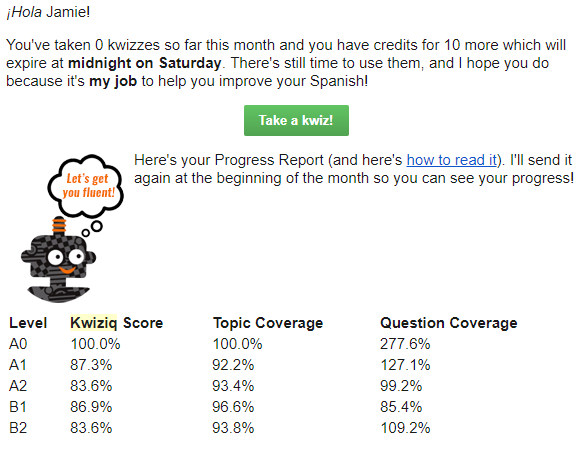
Kwiziq offers 10 free Kwizzes per month to everyone. I love this because the free content never expires! You can take free kwizzes as long as you want, they’re just limited. At the start of the new month, these 10 kwizzes are recharged.

This also means that you get your free kwizzes even if you were a member in the past but have since canceled, which is a thing that a lot of companies punish you for. If you cancel, you’ll still get an email once a month reminding you of free kwizzes that you have left, and when they’ll expire. Even if I’m not paying anymore, I still really like to be informed of free content that’s waiting for me.

Kwiziq review

Con: You can get a lot more for free elsewhere

Kwiziq isn’t the only guy out there with free quizzes to test your grammar fluency, but they’re the only one I know about that limits their quizzes. They are in competition with a couple of other resources that offer very similar products, with very similar information, all for free.

For example, Spanishdict is a great website with a free online Spanish-English dictionary, forum, and similar quizzes. These quizzes aren’t led by artificial intelligence, but they do a great job of providing you with the practice for some of these more difficult concepts.

Another popular free resource for grammar quizzes is StudySpanish. This website also has significant amounts of information available to help you understand your grammar, with some more hidden behind a paywall.

Note that both of these options are Spanish only. I’m not aware of similar resources for French as of this Kwiziq review.

Con: Kwiziq might be out of your budget

While Kwiziq is far from the only monthly membership platform to learn a language, it is on the pricey side. I do think the value is absolutely worth the price if you can swing it, and you specifically need to improve your grammar.

You can click here for Spanish pricing, and here for French pricing.

But don’t leave this Kwiziq review yet, there are still important features to talk about!

Pro: Kwiziq is more than just grammar

Primarily, Kwiziq is perfect for improving your Spanish and French grammar, but the other exercises in the “library” are excellent as well.

Just like Kwiziq’s grammar content, the exercises are also organized by A1-C2, so you get a really solid, in-depth understanding of your skill levels across the board, considering all 4 are rarely in the same place at any given time. And, honestly, I highly recommend Kwiziq for all language learners, if even just for these exercises.

In those practices (especially the last one), I love that it has you grade yourself. This is more flexible than the normal kwizzes, so you don’t have to mark yourself wrong for not seeing a word if you don’t find that necessary.

Then, of course, Kwiziq then links you to the individual lessons used in the statement, so you can figure out what you did wrong. If you’re not up to doing that research just yet, the icons to the right of the lesson links let you save them for later.

Still not quite getting it? All users are able to comment on the lessons and ask their questions, and Kwiziq’s Spanish teachers are actually incredibly responsive; if you’ve found something ambiguous and your question helps them see that something is confusing, they also have the power to make changes.

Plus, you can’t forget about the Weekend Workout! Every weekend, members get brand-new writing and listening challenges appropriate for every level sent directly to their email. It’s honestly a really nice reminder to keep up your practice, even if it’s only a little bit.

Kwiziq review: how to know if it’s the language app for you

At the end of the day, this Kwiziq review shows us a really great resource for French and Spanish learners. It has every grammar concept under the sun, and more are being added regularly.

Its gamification and easy-to-swallow kwizzes are addictive, which means that you’ll learn more grammar than you ever would anyways (let’s be real, most of us hate learning grammar). The exercises that are updated regularly are also a major win, I think.

If you’re not looking for grammar help, Kwiziq’s price point may not be worth it for you, depending on how much you use the other exercises. If you’re looking for something similar at a lower price point, I would recommend Yabla instead – not as pretty or user-friendly, but has similar types of exercises.

After reading this Kwiziq review, I would recommend all Spanish and French language learners, no matter the level, at least go through a few free kwizzes (click here for Spanish, or click here for French) and have the AI assess your level.

Filed Under: $101-200, $16-20, Advanced, Annual subscription, Audiobooks & video, Beginner, Communication, Daily streaks, Device, Explicit, Free, French, Gamification, Grammar, Implicit, Intermediate, Language app reviews, Language Skill, Level, Listening, Monthly subscription, Other Features, Pricing type, Reading, Spanish, Spelling, Stories, Target Language, Website, Words/phrases, Writing

Rosetta Stone review: for beginner language learners only

March 21, 2022 by Jamie Leave a Comment

Rosetta Stone has been a major name in the language learning world longer than most. This Rosetta Stone review will help you decide if it’s the language app for you.

Can you really get fluent using Rosetta Stone? Is it worth the money? Should you be considering it? In this Rosetta Stone review, I’ll touch base on all these questions, so you can make an educated decision on whether to take the plunge.

First things first, though, is to make sure Rosetta Stone actually teaches the language you’re interested in learning. Rosetta Stone offers the following languages:

  • Arabic
  • Chinese (Mandarin)
  • Dutch
  • English (American)
  • English (British)
  • Farsi (Persian)
  • French
  • German
  • Greek
  • Hebrew
  • Hindi
  • Irish
  • Italian
  • Japanese
  • Korean
  • Latin
  • Polish
  • Portuguese (Brazil)
  • Russian
  • Spanish (Latin America)
  • Spanish (Spain)
  • Swedish
  • Tagalog
  • Turkish
  • Vietnamese

Rosetta Stone review: what works

First off, let’s talk about how exactly Rosetta Stone accomplishes what it says it will accomplish. I’m very particular about making sure I’m practicing all of my language skills and knowing exactly what my goal is with any language.

That being said, how does Rosetta Stone work, and what does it teach you?

The closest thing to immersion

Rosetta Stone’s claim to fame is that it teaches you the language by immersion, which is great! And it’s true – you will never see or hear a single English word using this program. Using Rosetta Stone as an ultimate beginner is great because you’re learning to think using the language right off the bat; compared to other programs, where you’re translating between languages in order to learn, this is undoubtedly the best way to take in a language.

And Rosetta Stone is great for this very reason: it makes you think. With every round of questions, the way it’s designed forces you to actually think in the language. This is the first step in learning a new language authentically and efficiently.

So, if you’re starting out with the language fresh and new, the Rosetta Stone method is incredibly challenging, but in the best way.

The lessons may not go by as quickly and painlessly as Duolingo’s 5-minute lessons – you’ll spend a significant amount of time really using your brain, just like you would in real-life immersion. In fact, I had to take a break after the first 2 lessons because my brain hurt like it does when I’m in actual language exchanges!

Multiple-choice questions that you can’t fake

Another thing about Rosetta Stone that I really love is that you can’t really BS it. The program depends heavily on multiple-choice questions, but they switch it up. For example, you’re given a phrase, and then you’re given 4 pictures – your job is to match the phrase to the correct picture.

Once you’ve done that, not only is the text taken off the picture (so you still have four images to choose from for the next phrase), but the order of the pictures is flipped around. It’s just another level at which you actually have to think, as opposed to “well I’ve already matched up 3 pictures, so I don’t even have to look at the last phrase to know which picture it belongs to”.

It’s a simple thing, but it really makes a world of difference when it comes to making you actually think in the language, which, again, is one of the most important parts of effectively learning a new language.

Speaking from the beginning

Another thing that Rosetta Stone does really well is making you speak from day one. At the beginning levels, this is really helpful, as a lot of newbie language learners don’t realize that getting used to forming the words correctly is a skill in itself.

Foreign languages use different sounds, and just recognizing them by ear isn’t enough – you need to build muscle memory, and Rosetta Stone helps with that.

Rosetta Stone makes very large claims about speech recognition. I personally tend to take this with a grain of salt, because this isn’t the first time I’ve heard that, and it’s usually pretty useless. Most of the time, speech recognition is either easy to fake or says you’re wrong even when you’re right.

In my experience…Rosetta Stone’s speech recognition is about 50/50, as well. In some ways it has alerted me to how I’m pronouncing incorrectly, but whether or not it’s been a convenient fluke…who knows. I say that because after saying the same word with the same exact pronunciation four times and being told it was wrong the first three and right the fourth…it’s still not 100%.

So, take what it tells you with a grain of salt. Listen carefully, and absolutely practice your speaking, but I feel like there are better ways to go about that one.

…and all the other language skills

Yes, speaking is the big thing that most newbie language learners might avoid. Besides speaking, Rosetta Stone is surprisingly good at hitting the other language skills: reading, writing, and listening. Once you get through your core lesson, where you’ll learn all the things you need to learn about that unit, you’re also taken through lessons for each individual skill, which is amazing.

You get all of your language skills, appropriate to your level of learning, right in one go. Honestly, no other independent language learning resource does that, so in this way, Rosetta Stone is way ahead of the game (and has been for more than 20 years now).

That being said, this is a big deal. From the very very beginning, you get in the habit of practicing the language in every way necessary. Pretty good for beginners!

Rosetta Stone review: what doesn’t work

Now that I’m done raving on and on about how wonderful Rosetta Stone is, let’s talk about its failings. Now, keep in mind that it’s not that this program does things wrong necessarily – Rosetta Stone knows who its target audience is, and if these faults are a big deal, it’s not meant for you anyway.

I say this because I’ve seen plenty of reviews talking about how Rosetta Stone is heavily flawed, but so is every other language learning resource. Nothing is one-size-fits-all; if it were, there wouldn’t be a reason for all of these products. Know what you’re looking for in your language learning journey, and that will help you to make the right choice.

It’s repetitive

Right off the bat, Rosetta Stone can get infuriatingly repetitive. If you’re used to learning languages, and it’s easy for you to grasp linguistic patterns, Rosetta Stone is horribly boring and slow. The most basic words and grammatical patterns don’t need to be drilled so incessantly for learners who have already learned these same exact patterns in other languages.

If you’re an ultra-newbie this is great, because you’ll learn the basics and you’ll learn them well. However, if you’ve already done the legwork to recognize and be familiar with these basic patterns, you’re gonna get real bored real quick, which means you’ll give up.

Even with more advanced-level content, this was too slow. I tried to go into the settings real quick to speed it up, but no-go.

Rosetta Stone will provide you with a great base level to build on, which is great if you need it. If you don’t need it, don’t bother with it.

It’s basic

Rosetta Stone has 5 units of lessons for languages that are related to English, but only 3 or 4 for other unrelated languages. There is a lot of content, and the content is very thoroughly broken down into all of the language skills. It involves a lot of drilling and a lot of basic hand-holding.

However, the amount of drilling and hand-holding involved means that the content doesn’t get you very far. If you’re planning a trip abroad and want to feel comfortable understanding and communicating at a basic level, it’s very thorough and efficient. However, you won’t get much farther than that. And if you’re a seasoned language learner, you’re gonna get bored real quick, even if you’re still learning things.

You will not be learning intermediate or advanced words or concepts with Rosetta Stone. If you’re just starting out with the language, you’ll be fine, but there is no real building on the basics using this program. You’ll get a very solid root to the language, and you’ll be at a good place to push onward, but you can’t get onward depending solely on this program.

It’s expensive

This has been a major sore spot for Rosetta Stone since the beginning. Especially since the internet became a thing, and a variety of cheap or even free resources have become available, the steep price tag (think $200 for a single-level CD-set!) has turned a lot of people off.

As time has gone on, Rosetta Stone’s prices have become a bit more palatable by switching to a monthly model like a majority of the industry. The caveat is that you cannot invest month-by-month. You can see current prices here.

Fortunately, they do offer a 30-day guarantee.

Rosetta Stone review: stories

With stories, you get 3 different options for practice: read the story, read and listen, or read and read aloud. These stories are very on-level, and offer you another resource to practice both input and output.

I’m a big fan of listening to text while you read it, plus highlighting each individual word as it’s read? Two thumbs up!

When reading aloud with the story, the concept is exactly the same – the highlight tries to follow along with you word-by-word. It’s not exactly 100%, but it does the job enough.

Use this tool to listen to how you’re pronouncing the words, and then switch back to listening to compare.

My only complaint here is that I wish you had the option to download your recording. That way you could send it to a tutor or language exchange partner for feedback, or even just keep track of your progress for yourself.

Rosetta Stone’s audio companion

Then we have the audio companion. With each lesson, Rosetta Stone offers audio tracks of vocab pronounced correctly and slowly, with a beat after each word for you to repeat.

On mobile, you have the option to rewind, pause, and fast-forward; on desktop (as pictured), you just get the audio tracks downloaded straight to your device. In this case, it’s up to you to have a program that offers these options.

This first lesson had 18 audio clips (including the intro), by the way, not just the 3 shown here.

Rosetta Stone review: is it for you?

Rosetta Stone is a great language learning program that satisfies every language skill (that in itself is hard to come by), meaning you don’t have to look elsewhere for practice. If you’re a total beginner looking for a very confident base in the language, click here to get started with Rosetta Stone.

However, if you’re not a beginner or find the pace to be much too slow, I’d skip it. Instead, I’d recommend these comparisons if you’re interested in something similar:

  • Babbel vs Rosetta Stone
  • Duolingo vs Rosetta Stone
  • Pimsleur vs Rosetta Stone
  • Babbel vs Rosetta Stone vs Duolingo

Filed Under: $10-15, Android app, Arabic, Audiobooks & video, Beginner, Chinese (Mandarin), Device, Dutch, English, Farsi, French, German, Grammar, Greek, Hebrew, Hindi, Implicit, Intermediate, iOS app, Irish, Italian, Japanese, Korean, Language app reviews, Language Skill, Latin, Level, Lifetime access available, Listening, Monthly subscription, Polish, Portuguese, Pricing type, Reading, Russian, Spanish, Speaking, Speech recognition, Stories, Swedish, Tagalog, Target Language, Turkish, Vietnamese, Website, Words/phrases, Words/phrases

Verbling review: don’t sleep on this language teacher platform!

March 21, 2022 by Jamie Leave a Comment

In the language learning community, there are two well-known and well-trusted ways to practice having conversations with native speakers: italki and Verbling. They have their similarities and differences (as noted in my Verbling vs italki review), but now let’s focus on this Verbling review.

In this Verbling review, I’ll take you step-by-step through going to the Verbling website for the first time, all the way through your first lesson, pros and cons, and alternatives to Verbling for all your language learning needs.

Verbling review: find a private language teacher

Starting from the “Find a Teacher” button right next to the italki logo, you’ll find yourself confronted with a huge list of people who teach your target language, as well as a few options to narrow down your search.

As you can see, Verbling keeps the search criteria pretty simple: language, location (important because you may be more confident with certain accents), any particular goals you have, and availability.

In the past, Verbling used to allow you to search by gender, which was a huge plus for me. They seem to have removed this option, though.

After applying your preferred search, click through to any of the Verbling teachers that stand out to you. And if none stand out to you, pick one at random! You can learn about any teacher you like, including listening to their voice/accent, and hopefully getting to know them a little bit before booking a lesson.

You’ll find tons of information on the Verbling teacher you chose, like their resume, how long they’ve been on Verbling, how many lessons their average students take with them, detailed reviews, any articles they’ve written, and more.

It can be a lot to take in, but you only need to take what’s most important to you. The idea is to give you an opportunity for an educated choice before you spend your time/money on your first lesson, even if you opt for a discounted trial lesson.

Once you make your choice, you’re just 2 clicks away from your first Verbling lesson. They don’t make it difficult, which is helpful. I definitely understand the pressure of hitting that “buy now” button, so I appreciate how easy it is to get started.

Once you complete your trial lesson (or even before), you can also opt for bulk lessons with that teacher at a slight discount. This is a plus not only for convenience but also for accountability – you’re more likely to consistently practice if you’ve already bought the lessons.

It’s worth noting that the discount you get with bulk lessons differs from teacher to teacher (and not all Verbling teachers offer lessons in bulk) so don’t make any assumptions based on this Verbling review. However, this is a feature unique to Verbling.

What Verbling classes are like

If you’ve never taken an online class with a private language tutor, you can expect your language teacher to start a conversation with you by asking some getting-to-know-you questions.

This will likely be primarily over video chat, with the added perk of using the chat box to help with spelling or vocabulary. If your Verbling teacher has an activity for you, they’ll probably share their screen, like any Zoom call you’ve been in.

However, Verbling language lessons do not occur over Zoom or even Skype – they use Verbling’s own proprietary software and that’s it. This does make things easy when it’s time for your lesson because all you have to do with click a button and be connected.

Then, once your lesson’s finished, Verbling will email you summarizing your lesson. This summary can help you keep a record of when/how often you’re practicing, with whom, the vocabulary you referenced, and your conversation. If you really like your teacher, you can also go ahead and book another lesson right from this summary.

The Verbling community

If you’ve got a few minutes to spare, you can also check out Verbling’s Community tab. You may be able to find an interesting article or a future Verbling teacher you may like, but it’s definitely not Verbling’s strongest suit.

Honestly, it seems more like a side project than a full-blown feature.

If your teacher referenced an article they wrote or a discussion thread they started, you can also click on the My Teachers tab and easily find any of the content they posted. Or, if you’re just browsing around the Trending tab, and you find an article that you’re interested in or have a question regarding, each article links to the teacher who posted it, so it’s easy to send them a message asking for clarification, or (better yet) book a lesson to chat about it in the language you’re learning.

This option is definitely helpful for coming up with material to talk about in your lessons, as your teacher will probably ask you what you want to talk about after you’ve had your initial “getting to know you” lesson.

It can be tough to come up with good material for yourself, especially when your new language teacher doesn’t know you well enough just yet to recommend study material that will be engaging to you. Think of this section as Verbling’s library.

Verbling review

While Verbling (now a part of Busuu/Chegg) isn’t as popular or well-rounded as italki, this Verbling review shows that it’s still a great option for language learners who want focused conversational practice with professional native speakers.

There are a few key differences, as noted in my italki vs Verbling comparison review, but the most significant thing to know is that the value and experience you get from either platform depends not on the platform itself, but on the teachers you work with.

My recommendation? If you are looking for conversational practice with professional, experienced native speakers, Verbling is an excellent place to start.

You can also look for non-professional native speakers (so basically a glorified Tandem or HelloTalk language exchange) on italki, but regardless of your choice, don’t be afraid to shop around for a private language teacher on Verbling!

Filed Under: Advanced, Afrikaans, Ainu, Albanian, American Sign Language, Amharic, Android app, Arabic, Aramaic, Armenian, Assamese, Azerbaijani, Basque, Beginner, Belarusian, Bengali, Bosnian, Breton, Bulgarian, Burmese, Cantonese, Catalan, Cebuano, Cherokee, Chibemba, Chichewa, Chinese (Hakka), Chinese (Mandarin), Conversation, Conversation, Creole, Croatian, Czech, Danish, Dependent on Users, Device, Dutch, Dzongkha, English, Esperanto, Estonian, Farsi, Feedback, Fijian, Finnish, Flemish, French, Gaelic, Galician, Georgian, German, Greek, Greenlandic, GuaranĂ­, Gujarati, Hakka, Hausa, Hawaiian, Hebrew, Hindi, Hokkien, Hungarian, Icelandic, Igbo, Ilocano, Indonesian, Intermediate, iOS app, Irish, Italian, Japanese, Javanese, Kachchi, Kannada, Kazakh, Khmer, Kinyarwanda, Korean, Kurdish, Kyrgyz, Language app reviews, Language Skill, Latin, Latvian, Level, Listening, Lithuanian, Macedonian, Malagasy, Malay, Malayalam, Maltese, Manx, Maori, Marathi, Mongolian, Navajo, Neapolitan, Nepali, Norwegian, Occitan, Ojibwe, Oriya, Oromo, Other Features, Papiamentu, Pashto, Persian, Pidgin (Nigerian), Piedmontese, Polish, Portuguese, Potawatomi, Private, Professional, Punjabi, Reading, Romanian, Russian, Saami, Samoan, Sanskrit, Sardinian, Scots, Scottish Gaelic, Serbian, Shangainese, Shona, Sicilian, Sindhi, Sinhala, Slovak, Slovenian, Somali, Spanish, Speaking, Stories, Swahili, Swedish, Swiss German, Tagalog, Tamil, Target Language, Telugu, Thai, Tibetan, Tigrinya, Tok Pisin, Turkish, Tuvan, Twi, Ukrainian, Urdu, Uzbek, Vietnamese, Website, Welsh, Wenzhounese, Yiddish, Yoruba

LingQ review: probably not worth your time

February 3, 2022 by Jamie 2 Comments

LingQ (pronounced like ‘link’) is excellent for language learners who want to pick up vocabulary through reading and listening to audiobooks, stories, podcasts, etc. Given that it’s such a huge, popular resource, there’s a lot to say about it – some of it good, some bad. In this LingQ review, you’ll get a taste of it all.

In this LingQ review, learn if LingQ is the language app for you, or if it’s just not worth it.

LingQ review: languages

One thing that’s excellent about LingQ is that you can create your own content (more on that later) in the following languages:

  • Arabic
  • Chinese (Mandarin)
  • Czech
  • Dutch
  • English
  • Esperanto
  • Finnish
  • French
  • German
  • Greek
  • Hebrew
  • Italian
  • Japanese
  • Korean
  • Latin
  • Norwegian
  • Polish
  • Portuguese
  • Romanian
  • Russian
  • Spanish
  • Swedish
  • Turkish
  • Ukrainian

LingQ review: your dashboard

LingQ’s dashboard has been modernized in recent years, in an effort to be a more “bingeable” way to learn languages.

There’s a lot of information to take in, and I wish there were some sort of tutorial or something first because if I hadn’t been using this platform for years, I would have no idea where to start!

LingQ has a history of being…not very user-friendly, and that hasn’t changed. There’s a lot to take in here.

  • every video shows you how many words you know and how many you don’t*
  • you can see the percentage of words you don’t know*
  • while each cover photo is in your target language, it’ll automatically translate as soon as you roll over it
  • you can scroll through different categories of audio lessons, including Steve Kaufmann (co-creator of LingQ)’s podcast
  • you can search for specific content based on level or keywords

*neither of these stats is accurate if you don’t use LingQ religiously

Of course, like any other Netflix-esque platform, the more you use it, the better it can recommend you content that you’ll actually use.

So let’s move onto what it’s like to actually learn a language with LingQ.

LingQ review: basic lesson

Click to any video that you can see on your dashboard to get started with a LingQ lesson.

Once you press play, you’ll hear an audio recording in your target language, and it’s your responsibility to follow along with the written words.

Don’t get distracted or lost, though, because there’s literally no way to find your way back if you do. There’s on highlight to follow along with…the audio doesn’t even automatically turn the page, so you can be at the end of the audio but still on the first page, and you wouldn’t even know.

Plus, collecting new vocab words (i.e. LingQs)? What a pain. Not only does the audio not automatically stop to give you a second to learn the new word, but it gives you a robot voice for that word instead of just rewinding the audio a little bit.

I hate it. Maybe I’m spoiled by Language Reactor which makes it genuinely easy to learn new vocabulary by watching foreign language movies and TV. But just in that clip alone, I was stumbling so hard to pause the audio and catch up wit the word I just collected, I completely lost track of everything.

The idea is to make language learning easier, not more difficult.

LingQ review: words and lesson history

To find the LingQs (vocab words) you’ve collected within these lessons, click over to Vocabulary.

Again, LingQ’s usability is…wanting. While you do get to see how (theoretically) well you know any particular term, it’s hard to see what you’re supposed to do here. Again: mild inconvenience for some, completely handicapping for others.

The actual system of learning these LingQs definitely has potential, but it could also use some real help.

Fortunately, if you like finding your vocab using this method but have your own flashcard deck elsewhere, you can export all of your vocabulary to a CSV file, and upload that to any resource that’ll accept it.

The last tab, Playlist, holds your place if you’re in the middle of a book or series. This is definitely handy for when you click something in your Library feed, and it’s in the middle of a playlist or book.

Importing content to LingQ

LingQ has a plethora of practice options – tutors, forums, challenges, etc. – but I don’t want to spend time on those because they’re not really worth your time. There are plenty of other language learning resources that already do these things much better than LingQ could.

The important feature to know about LingQ is the ability to import content to use with LingQ’s technology

Anybody with an account can upload whatever content they like to the platform, and LingQ will stick it right into your feed. Either click the import button right from your dashboard or download the Chrome extension to import from anywhere on the internet.

You have three options: lesson, ebook, and vocab.

And, honestly, it’s pretty cool if you’re looking for a place to host your content all in one place, plus keep track of the vocabulary you’re learning in a centralized platform.

LingQ review: price

You can access any content at any time for free!

However, if you want to use LingQ as your primary language learning platform, you’ll definitely need to pay for premium due to the unlimited LingQs and unlimited imports.

You’ll also get access to all the other perks that I haven’t really mentioned in this LingQ review since other resources do those things much better, but if you decide to pay for premium, it might be worth taking advantage of them.

You can find updated prices for LingQ Premium here.

LingQ review: the bottom line

At the end of this LingQ review, it can be a great resource for you if the lack of usability doesn’t get in the way for you. If it’s as handicapping for you as it is for me, though, there are plenty of alternatives.

Readlang is my favorite for finding words and articles on the internet.

Lingvist is excellent for creating themed vocab lists, or lists from books you’re reading.

Language Reactor is best for new vocab in YouTube and Netflix media.

But if the cons mentioned in this LingQ review don’t dissuade you, LingQ is a solid option for finding new foreign language vocab through a variety of content available online!

Filed Under: $10-15, $101-200, $31-40, $400-500, Advanced, Android app, Annual subscription, Arabic, Audiobooks & video, Beginner, Chinese (Mandarin), Chrome Extension, Czech, Device, DIY flashcards, Dutch, English, Esperanto, Finnish, Free, French, German, Hebrew, Intermediate, iOS app, Italian, Japanese, Korean, Language app reviews, Language Skill, Latin, Level, Listening, Monthly subscription, Norwegian, Polish, Portuguese, Pricing type, Reading, Romanian, Russian, Spanish, Stories, Swedish, Target Language, Turkish, Ukrainian, Vocabulary, Website

Duolingo Review: how to use Duolingo in 2023

January 19, 2022 by Jamie 2 Comments

Ah, Duolingo. The internet’s most famous place to study foreign languages. It’s cute, it’s bite-sized, and it makes you feel good. All that surface-level stuff aside, does Duolingo work? Is Duolingo good for all types of language learners? We’ll discuss in this Duolingo review.

And if Duolingo is the answer for you, how do you take advantage of everything that it has to offer (which is a lot)? That’s where this Duolingo review comes in.

How to use Duolingo

The first question for this Duolingo review: is Duolingo effective? It can be, as long as you understand what it’s used for. What I mean by that is Duolingo does not offer conversational practice, any independent speaking, reading, or writing. There’s a teeny tiny bit of listening when you’re learning the words, but that’s about it.

1. Overview of Duolingo
2. Lingots
3. Duolingo’s learning path
4. Other features
5. Duolingo Leagues
6. Duolingo Achievements
7. Super Duolingo
8. Duolingo alternatives

That being said, the question of “how effective is Duolingo” is…a mixed bag. For what it does, it can be very effective! Because of the tools it provides (i.e. reminders, gamification, competition), Duolingo is effective for:

  • Learning beginner vocab and beginner-intermediate grammar (in some languages)
  • Forming a daily habit
  • Making language learning fun
  • Creating competition

And, most importantly, making language learning free and accessible to all.

You’re not going to get conversational using just Duolingo, but you can easily get a very solid base in the language, with which you can search elsewhere in the world for more advanced concepts and actually practice your fluency.

Duolingo can be a great start for your language learning in a variety of languages. The languages you can find on Duolingo include:

  • Arabic
  • Chinese
  • Creole
  • Czech
  • Danish
  • Dutch
  • Esperanto
  • Finnish
  • French
  • German
  • Greek
  • Hawaiian
  • Hebrew
  • Hindi
  • Hungarian
  • Indonesian
  • Irish
  • Italian
  • Japanese
  • Korean
  • Latin
  • Navajo
  • Norwegian
  • Polish
  • Portuguese
  • Romanian
  • Russian
  • Scottish Gaelic
  • Spanish
  • Swahili
  • Swedish
  • Turkish
  • Ukrainian
  • Vietnamese
  • Welsh
  • Yiddish

Duolingo also offers fantasy languages, like Klingon and High Valyrian; suffice to say, you’re more than covered for language learning inspo.

How does Duolingo work?

Duolingo works by providing you with a bunch of little, incremental lessons that are easy to consume, and constantly giving you positive reinforcement via adorable sound effects, awards, and notifications. It absolutely is addicting, and that’s their MO. They get you addicted to coming back and spending even just 5 minutes with them.

On top of that, with Leagues and XP, you can use Duolingo to find motivation via competition against other language learners regardless of target language, goals, and skill level. I’ll go more in-depth about this later.

Lingots

“Lingots”(pronounced ling-guhts) are Duolingo’s currency. You earn lingots by:

  • earning crowns in any skill
  • finishing any skill
  • practicing
  • continuing a streak for a specific number of days
  • finishing a League in 1st, 2nd, or 3rd place

When you only have to study on Duolingo for 5 minutes a day, it’s really not hard to see why you’d keep coming back. This is why Duolingo depends heavily on Lingots to keep Duolingo users hooked.

With these lingots, you can buy:

  • streak freezes (if you forget to come back one day, you won’t lose your current streak) (
  • double or nothing (double your wager if you maintain a 7-day streak)
  • extra minutes in timed practices
  • hearts (AKA more practice)

In the past, lingots could be used to buy several other things as well, like outfits for Duo the owl. However, today your options are limited, and this is one of the many updates to Duolingo that users are not happy about.

For free Duolingo users, “hearts” also play a major part in the Duolingo experience; you automatically get 5 hearts; whenever you get a question wrong, you lose a heart.

You can keep learning until you get 5 wrong, and lose all 5 hearts. Once you lose all your hearts, you have three options:

  • quit playing and wait to get 1 heart every 5 hours
  • buy more hearts with lingots
  • earn 1 heart by practicing old skills
  • get Duolingo plus (to be explained later)

Duolingo review: the learning path

Duolingo teaches languages by way of a learning path. These learning paths are made up of bite-sized lessons collected together and organized by skill. Because Duolingo is as gamified as it is, and these lessons are so easy to swallow, it’s not hard to push yourself to learn more and more; not only that, but Duolingo has so many adorable little achievements and reminders that it’s easy to stay in the habit, which is awesome.

Unfortunately, even though these lessons are based on grammatical concepts, they’re not named specifically based on that. For example, the “City” skill doesn’t teach you the name of cities, but words like “store”, “small”, “school”, etc. Kind of confusing. I wish they took the LingoDeer approach of having lesson titles match up with the actual lessons.

Here you can see a lesson about “changes” under the unit about places being…neither of those.

These skills are organized by level, and for the more extensive languages (namely Spanish and French), Duolingo will ease you into a more and more advanced understanding of the language.

For the more extensive languages, there are 5 crowns per skill (on mobile you may have 6 crowns per skill, the last crown, “Legendary”, being a review worth 40 XP). Each of these crowns is broken up into 5 levels, and each of those levels has 10 questions each.

One of the things to keep in mind with Duolingo is that even though there are a ton of languages to learn, not all of them are as complete as some of the more common foreign languages.

That said, more commonly learned languages like Spanish have a significantly longer learning path than something like Finnish.

Regardless of the language, Duolingo is best for language learners with little to no experience in a given language. If you’re an intermediate learner of the more commonly-learned languages, you may also find Duolingo valuable.

This is because of the “Checkpoint” feature of Duolingo. If you’re not a total beginner of the language, you can take and pass Checkpoint Challenges to show Duolingo what you know, and get to the lessons that’ll actually be beneficial to you.

Again, this does depend on the language you’re learning, as well as your abilities. These Checkpoint Challenges are not easy – simple mistakes make a big difference.

Otherwise, Duolingo’s learning path guides you one lesson at a time. Many users complain that they’d like more choices as to what they’re learning at any given time; if you don’t want to take that particular lesson, you’re stuck.

There are other things to do in Duolingo that are not connected to the learning path to give you something else to do, like separate speaking/listening exercises.

Duolingo review: other options

In the past, Duolingo offered users more options: which skills to learn, when to learn them, and how many repetitions they want. With the new learning path, those options are totally gone; users must take the next lesson, or else they can’t move on.

For Super Duolingo users (i.e. paid members) on mobile devices, there are a couple of other options. Timed practice, for example, has users review vocab at breakneck speeds to earn more XP and get to the top of the League leaderboards.

Users might also find timed practice with more advanced content, like translating to transcription (listen to an audio clip and write down what they’re saying).

Suffice to say, Duolingo truly changes things up (albeit inconsistently – they’re known for their A/B testing, so it may take a while for updated exercises to hit your account).

Here’s a tip for you if you want to use Duolingo: try to focus on these kinds of comprehension questions, if you can:

These are excellent because they lead users to use their language skills together with their critical thinking skills to check for understanding.

Simple, brainless, matching exercises will only take you so far, so I’m glad to see these more complex exercises.

As you continue through Duolingo’s learning path, you’ll also work through Duolingo Stories; again, this is one of their better features for genuinely building comprehension skills in an engaging way.

It is worth mentioning that you can commonly get questions wrong because of a typo that isn’t relevant to the actual thing you’re being tested on. I can’t tell you how many times I’ve gotten questions wrong because the sentence started with “Julie” and my phone auto-corrected to “Julia”. Super frustrating.

PRO TIP: add the language you’re learning to the keyboard on your phone! This’ll reduce the number of silly autocorrect mistakes.

Duolingo Leagues

Let’s talk about the competition aspect of Duolingo: Duolingo’s leagues exist as yet another level of gamification to keep you coming back to the app.

Everything that you do in Duolingo earns you at least 10 XP. You can earn more by not making any mistakes, reviewing your mistakes, or doing separate speaking/listening exercises (Super Duolingo users only).

This XP is used to pit users in competition with each other for the next week, based on when they started the week.

The purpose of Duolingo’s leagues is to motivate you to practice enough to get to the Diamond League.

Every week, you get pitted against 25 other Duolingo learners (regardless of language, skill level, etc.) who started their Duolingo week at the same time as you. You move forward, backward, or stay in one of 10 leagues from week to week:

  • Bronze
  • Silver
  • Gold
  • Sapphire
  • Ruby
  • Emerald
  • Amethyst
  • Pearl
  • Obsidian
  • Diamond*

Each of these leagues is a week long, which means it’ll take you at least 10 weeks to get to Diamond League. Competing against 25 other language learners, you have a week to:

  • graduate to the next league by finishing in the top 10 (plus earning lingots if you finish in the top 3)
  • stay in your current league by finishing in spots 11-20
  • get demoted to the prior league by finishing in the bottom 5

If you get to the Diamond League, there’s one more challenge for you: stay in that league for 3 weeks to earn all 3 pieces of the Diamond. It won’t be easy, though, especially at the very end. Some users use illegal bots to earn thousands of XP points just to earn the coveted award.

Achievements

As you continue on through Duolingo, you’ll get cute little achievements here and there. Things like following 3 friends, adding a profile picture, maintaining your streak for a varying number of days, etc.

There is one important achievement that really raises the stakes, especially in the Diamond League. This achievement is the Legendary award.

The only way to achieve this is to finish the Diamond League in the #1 position. This means that the Diamond League can get FIERCE! Not to mention stressful.

Sometimes the Diamond League is pretty chill and the winner only had 2,000 XP or so, and sometimes the top 2 players are fighting till the death, and the #1 finishes with something like 10,000 XP.

So yeah, it can get crazy.

How does one land this extra special achievement? I have a couple of tips (that don’t involve the bots that some people absolutely use to cheat) just for this Duolingo review.

  1. Don’t start the league until the last minute
    Leagues are events that restart every week, but timing can be a big deal. Think of others who are lazy or busy, and can’t maintain their streak until the last minute. Try waiting until the very last minute to join the league – you can even use a streak freeze to really put it off and still maintain your streak!
  2. Check out the competition before you get too crazy
    I’ve been in leagues where players have used bots to earn 8,000 XP in the first hour of the league. There’s no point in competing against that. If you find you’re in a league with players who are too competitive, maybe wait til next week.
  3. Work through old lessons or a language you already know
    If your goal is to get as much XP as possible, don’t worry about learning new things. Go through beginner lessons in your language, or if you’re already at an advanced level of another language, go through that tree. Remember, the specific language you’re studying has no weight in Leagues.
  4. Take advantage of your free Duolingo Plus trial
    Duolingo Plus means no ads. Take advantage of the time saved! When you ditch the ads, you save a few seconds each lesson, and that can really add up (or at the very least remove the frustrations of ads when you’re already stressing your XP).

Super Duolingo review

Duolingo’s thing is free education forever. There are no gimmicks, no surprise “if you want to keep learning, pay us!”, nothing, which is great, especially for a large, publicly traded company.

But as time goes on, more and more users have a bad taste in their mouths with Duolingo and believe that they’re trying to focus more on monetizing the site than focusing on providing a great, accessible language learning app.

Whether that’s true or not is not for me to say. With the free app, the only disturbance you’ll get to your language learning is ads. With the hearts system, you’ll also be disrupted if you get 5 questions wrong.

If you really care to get rid of the ads (as well as get a couple of perks), you can opt for Super Duoilingo. If you want to try it out, every account gets free access to Super Duolingo for 14 days. You’ll get to try out:

  • no ads
  • unlimited hearts (i.e. unlimited learning)
  • mistake practice (any exercises you get wrong)
  • unlimited Legendary (do an exercise and your final lesson turns purple)

In my opinion, sticking to the free Duolingo won’t break your language learning experience; however, if you find yourself using it a lot and would benefit from some extra learning tools, there’s no harm in using your free trial.

You can opt for Super Duolingo either in the app or on desktop.

Duolingo alternatives

If after this Duolingo review you’ve decided it doesn’t quite suit your language goals, what are some Duolingo alternatives?

If you like the heavy gamification (easy to use, great colors, and fun sounds/animations), you may prefer Mondly or Drops which are both great for beginners who want to build their foreign language vocabulary.

Or, if you like the usability but want to learn vocabulary that you’ve found or are more relevant to your own personal interests/goals, I’d recommend Lingvist or Quizlet.

Finally, if you’re learning a language from scratch and want a structured path but can’t deal with Duolingo’s heavy gamification, you can try Rosetta Stone or Babbel (this post compares all 3 resources!).

Duolingo review: who it’s for

If you’ve made it this far into this Duolingo review, it’s the moment of truth: will Duolingo help you learn a language?

Duolingo is appropriate if you:

  • want a simple way to practice a language
  • thrive off reminders and happy sounds
  • are just starting out learning a language for the first time
  • know absolutely nothing in the language

However, steer clear if you:

  • are focused on getting conversationally fluent
  • are looking for a high-quality language education
  • get annoyed by constant reminders
  • want to learn sentences you’ll use in real life
  • want explicit grammar instructions (not “figure it out as you go”)

Sold? Click here to get started with Duolingo!

Filed Under: $1-9, Android app, Arabic, Beginner, Chinese (Mandarin), Conversation, Creole, Czech, Daily streaks, Danish, Device, Dutch, Esperanto, Finnish, Free, French, Gamification, German, Grammar, Greek, Hawaiian, Hebrew, Hindi, Hungarian, Implicit, Indonesian, iOS app, Irish, Italian, Japanese, Korean, Language app reviews, Language Skill, Latin, Level, Listening, Monthly subscription, Navajo, Non-English base language, Norwegian, Notifications, Other Features, Polish, Portuguese, Pricing type, Reading, Romanian, Russian, Scottish Gaelic, Spanish, Speaking, Speech recognition, Spelling, Stories, Swahili, Swedish, Target Language, Turkish, Ukrainian, Vietnamese, Website, Welsh, Words/phrases, Words/phrases, Writing, Yiddish

Primary Sidebar

Meet your language coach

Hi! I'm Jamie (she/her), and I help you learn exactly what you need to do to learn a foreign language. Click my face above to learn more about me and how I can help.


We strive to offer equitable access to language learning for all, regardless of ethnicity, gender identity, ability, or sexual orientation.
Copyright © 2025 · Multilingual Mastery · Privacy Policy

  • About
  • Get 1:1 support
  • App search