• Skip to primary navigation
  • Skip to main content
  • Skip to primary sidebar
Multilingual Mastery

Multilingual Mastery

Online language learning coaching & education

  • About
  • Get 1:1 support
  • App search

Implicit

Ling Review: make language learning light and flexible

January 12, 2024 by Jamie Leave a Comment

Ling is a fun, cute language learning app that believes in making language learning (something inherently difficult) easy. It was originally created to satisfy a lack of resources available for learners of Southeast Asian languages, and today it’s been expanded to include over 60 languages of various popularities.

So how do you decide if Ling is right for you? In this Ling review, we’ll talk about what Ling does well, what it doesn’t, how to know if you should use Ling to learn a language, and Ling alternatives.

Languages you can learn with Ling

The Ling app boasts a frankly huge number and variety of languages offered! You can use Ling to learn:

  • Afrikaans
  • Albanian
  • Amharic
  • Arabic
  • Armenian
  • Bengali
  • Bosnian
  • Bulgarian
  • Burmese
  • Cantonese
  • Catalan
  • Chinese
  • Croatian
  • Czech
  • Danish
  • Dutch
  • English
  • Estonian
  • Finnish
  • French
  • Georgian
  • German
  • Greek
  • Gujurati
  • Hebrew
  • Hindi
  • Hungarian
  • Indonesian
  • Irish
  • Italian
  • Japanese
  • Kannada
  • Khmer
  • Korean
  • Lao
  • Latvian
  • Lithuanian
  • Malayalam
  • Malaysian
  • Marathi
  • Mongolian
  • Nepali
  • Norwegian
  • Pashto
  • Persian
  • Polish
  • Portuguese
  • Punjabi
  • Romanian
  • Russian
  • Serbian
  • Slovak
  • Slovenian
  • Spanish
  • Swahili
  • Swedish
  • Tagalog
  • Tamil
  • Telugu
  • Thai
  • Turkish
  • Ukrainian
  • Urdu
  • Vietnamese
  • Yoruba

As you can see, this collection of languages puts Ling on par with apps that support literally dozens of languages (apps like Mondly and Glossika come to mind). And just like those other apps, supporting 60+ languages means keeping their content pretty surface-level.

But we’ll talk about that more as we continue with this Ling review.

Ling review: getting started

Your Ling subscription grants you access to all 60+ languages, and you can access any of them at any level at any time. Here’s what that looks like.

Whenever you want to switch languages, just tap the flag in the upper left-hand corner and either scroll the list or type into the search box.

And no need to bother with any “checkpoints” or anything – attempt whichever lessons you want at any time. I love this freedom and flexibility; language learning does benefit from a certain level of structure, but I find myself easily unmotivated when an app forces me to study things I don’t want to learn.

So far, Ling is super easy to play around with and use!

Let’s take a look at the very first lesson of the very first section, built for total and complete beginners (I assume – there’s actually no mention of the intended skill level anywhere on the website or the app itself).

This is a curious approach, and there are a couple of reasons why.

Gamification

If the likes of Duolingo have taught us anything in the past several years, it’s that keeping language apps fun keeps language learners coming back. Bright colors, round and easy-to-read designs, and fun sound effects make people feel good.

It’s not nearly as annoying as Duolingo can be, but if you’ve been burned hard enough by Duolingo before, this might turn you off.

You can even see at the end of the above video where the app forces me to set a goal streak. Your opinion of this level of gamification already says a lot about how much you will or will not enjoy using Ling to learn a language.

That said, if gamification is something you need to keep you hooked (no judgment here) Ling might be a great option.

Implicit grammar lessons

Also just like Duolingo, Ling is teaching grammar implicitly, which means you’re led to figure it out as you go without being intentionally taught anything about rules or how the language works as a whole.

This can be seen as a more “natural” way to learn a language, but it can also be frustrating to try to piece the language together without being told how to. It’s a spectrum – how much you need to learn the rulebook, and how much you just need to try it – and every language learner is different.

If you want to use Ling to learn a new language that you have no experience with and is not related to any other language you know, it’s important to understand you will likely need to do some Googling to try to understand some things.

In this way, Ling can be used as more of a general path to be informed about what to learn next. There’s a direction here, but the vehicle you used to take it is completely up to you,

Translating vs “knowing”

One more thing that can make or break a language app for any particular learner is how you’re learning to connect to the meaning of new vocab words.

The best example of learning to understand meaning is Rosetta Stone – there’s no translation happening there, you’re just connecting new words to images that can be described with the new vocab word.

On the other hand, there are various levels of connecting new foreign language vocab to words in your native language, which leaves you translating back and forth between languages all the time.

Ling places you somewhere in the middle: you’re connecting new vocab to its translation, but the text is small, you’re always hearing the word, and you get a picture too. That’s not a bad compromise, in my opinion.

Even more important, though, is that Ling gets you to use the new vocabulary immediately.

Ling review: speaking practice

Ling’s approach to learning languages includes their dedication to the four language skills. An all too common problem is these fun, gamified language apps doing absolutely nothing to get language learners to speak the language. Tapping buttons is easy, but it only gets you so far.

Let’s see how Ling approaches this problem.

Voice recognition, the most common method for language apps to accomplish this, is mostly to motivate you to try. Even in the above video, you can see the voice recognition not being too sure.

It gets the job done, it’s fine.

Honestly, the point is that language learners are led to start. It’s often so hard for people to practice speaking their target language just because after months or years of learning, they’ve never actually tried to speak.

Ling also has chatbot conversations, which are basic pre-made conversations where you just repeat your side of the chat (and try to keep up). Again, it’s meant mostly to get you started speaking, not mastering it.

I wanted to like Ling’s chatbot more…but I couldn’t. I just got annoyed.

If it didn’t recognize my pronunciation, fine. But the message telling you that the chatbot doesn’t understand you over and over and over again is rage-inducing!

That, and listening to the app repeat what I just said after I said it, made me never want to use Ling’s chatbot again.

Hopefully, you have a different experience than I did (voice recognition and chatbots often vary significantly across devices), but I have to be honest.

On the bright side, I am a big fan of the ability to turn off the translations in this section, as well as the push to practice speaking in a safe, controlled environment (this feature cannot be overstated here).

Ling review: difficulty level

In the languages I’ve seen, Ling offers lessons labeled from total beginner to expert. Given how many languages the app supports, I was skeptical, so I took a look at the most advanced Spanish lesson.

Definitely not expert-level vocab.

The grammar is at a more intermediate level, but keep in mind that there are no explicit grammar lessons, so you either need to be very very good at picking up patterns, or you need to find your grammar information elsewhere.

That said, do not expect Ling to get you to advanced (and definitely not expert) levels within your target language. That’s not what it’s been created to do, even if they named their levels a bit too optimistically.

Ling review: pricing

Ling is a paid-only app, with payment structures varying from monthly to annually to lifetime. Only the annual plan includes a 7-day free trial.

I do believe that the quality of the Ling app reflects its price point, especially with how many languages you can learn at any time.

The biggest thing to keep in mind here: no ads (and no changes to try to pressure you into paying more money – what you see is what you get).

Click here for updated pricing.

Should you use Ling to learn a language?

Ling is a great way to learn a new language, but not for everyone.

I’m a fan of the focus on all 4 language skills; even if it doesn’t get you past beginner levels, it’s a good habit to start with such a well-rounded approach. The app is also easy on the eyes and easy to maneuver.

But my favorite part about Ling is that it’s a light path to learning a new language, without having to pass checkpoints or worry about losing so many hearts you can’t learn anymore.

If you want something similar to Ling, read about LingoDeer.

However, Ling will not teach you things beyond the surface level. You will not learn any grammar, or intermediate/advanced vocabulary. If you’re looking for that pathway with a bit more detail, some Ling alternatives include LanguagePod101 or Rocket Languages.

Want to give it a shot? Click here to try Ling.
Filed Under: $10-15, $50-100, Afrikaans, Albanian, Amharic, Android app, Annual subscription, Arabic, Armenian, Beginner, Bengali, Bosnian, Bulgarian, Burmese, Cantonese, Catalan, Chatbot, Communication, Croatian, Curated flashcards, Czech, Daily streaks, Danish, Device, Dutch, English, Estonian, Finnish, French, Gamification, Georgian, German, Grammar, Greek, Gujarati, Hebrew, Hindi, Hungarian, Implicit, Indonesian, iOS app, Irish, Italian, Japanese, Kannada, Khmer, Korean, Language app reviews, Language Skill, Lao, Latvian, Level, Lifetime access available, Listening, Lithuanian, Malayalam, Malaysian, Marathi, Mongolian, Monthly subscription, Nepali, Norwegian, Notifications, Other Features, Pashto, Persian, Polish, Portuguese, Pricing type, Punjabi, Reading, Romanian, Russian, Serbian, Slovak, Slovenian, Spanish, Speaking, Speech recognition, Swahili, Swedish, Tagalog, Tamil, Target Language, Telugu, Thai, Turkish, Ukrainian, Urdu, Vietnamese, Vocabulary, Words/phrases, Words/phrases, Writing, Yoruba

Ella Verbs review: your best bet for Spanish conjugation practice

May 31, 2023 by Jamie Leave a Comment

Ella (not pronounced like “she” in Spanish, but like “elephant”) Verbs is a language app that specializes in helping users to understand and conquer their Spanish verb conjugations – if you have any experience learning Spanish, you know that this is a sorely needed resource. In this Ella Verbs review, let’s take an honest look at the app, including what it does well, where it can be improved, and if it’s the Spanish language app for you.

Ella Verbs review: their “Learn, Quiz, Repeat” ethos

Before we look at what it’s like to use Ella Verbs, it’s important to understand the bare-bones strategy of Jane and Brian (the Irish couple behind the app)’s approach: learn, quiz, repeat. This is how these words are executed in your learning of Spanish verb conjugations:

  • Journey: Ella Verbs guides you through the major Spanish tenses, in the order that they are most used in conversation, allowing you to put them into practice as soon as possible and get speaking faster – AKA, worry about the fancy “correct” tenses later, after you can have a basic conversation
  • Levels: each level is made up of bite-sized lessons introducing a concept, followed by interactive quizzes to test your knowledge*
  • Vocabulary: Ella Verbs gradually introduces new popular verbs at every level, so by the time you are finished, you will know the top 300 verbs used in most conversations
  • Progress: a detailed progress map, showing you each corresponding CEFR level (A1 – C2), and highlighting the areas you need to focus on to get to the next level
  • Personalized: quizzes tailored to you, help you focus on your weak points – be it a certain tense, pronoun, or verb. These quizzes change daily based on your practice
  • Custom: learn the way you want and completely customize your quizzes, whether that be typing, multiple choice, or in sentences. You can also add boosts to increase the difficulty

*Consistently quizzing your conjugations is proven to facilitate long-term retention better than reading, so this is one of Ella Verbs’ most important and core ideas.

Let’s take this ethos and see how each point is executed!

Journey

First, let’s look at the Ella Verbs journey. Here you can see that users are guided through verb conjugations in the order that they’re actually useful (and as compared to the CEFR levels):

Ella Verbs does this really well! It’s simple, easy, and gets the job done. Plus, I love that it waits for you to spell the words correctly – when you get it right, it automatically continues to the next question (this can be changed in settings if you prefer); if it’s wrong, it’ll wait til you figure it out for yourself (and it won’t ding you for wrong answers!).

This is excellent for Spanish language learners who can be sensitive to negative reinforcement (I will get so anxious about consistently getting these wrong that it’ll ruin my day).

As you prove your understanding of more beginner levels, you’ll slowly be pushed to the more advanced ones. And if you’re already more intermediate/advanced? Just click over at any time, you don’t even have to “prove” your understanding of the conjugations.

Speaking of levels…

Levels

Each level is made up of short, easy-to-consume lessons to explain the concepts. When you’re ready, it’s time to quiz!

In the video below, watch as I complete Level 6: Learn, Test, and Vocabulary.

As you can see, while the lessons themselves are insanely bite-sized, they also quickly build up to enough of a lesson that I had to quit early because my brain got tired!

It really only takes a few minutes of truly targeted, active use of these Spanish verb conjugations to get your brain working pretty hard and get this information truly internalized. This is how you know you’re using your time effectively, as opposed to passively pushing buttons because you’re supposed to, not because you’re learning anything (*cough cough* Duolingo).

And that’s how you know this Ella Verbs review is legit! Next up: vocab.

Friendly reminder that Ella Verbs is exclusively a verb app!

Vocabulary

As aforementioned, new vocabulary is introduced in the order that is most useful for Spanish language learners. Not only that, though – the verbs you see in your quizzes are insanely customizable!

Like many language apps, Ella Verbs gets better and better at knowing what you need when you need it the longer you use it. One of the (many) features that I love in this vocabulary section is the use of My Verbs.

But I’m getting ahead of myself here. Tap over to the “Verbs” section of the app to easily personalize which verbs you’re using and learning.

You can easily search for, and practice, verbs based on:

  • alphabetical order
  • top 100 most commonly-used verbs
  • the verbs you’ve saved for later
  • top 300 most commonly-used verbs
  • regular verbs
  • irregular verbs
  • most popular irregular verbs
  • AR verbs
  • ER verbs
  • IR verbs
  • reflexives
  • highly irregular verbs
  • stem-changers
  • irregular gerunds
  • irregular past participles

…and if all those options STILL don’t work for you at the moment, you can always search for the verb you’re looking for using the search bar at the top of the screen.

Of course, you’ll still have to find your nouns elsewhere, but that’s just something to be aware of when using a language app that focuses exclusively on Spanish verb conjugations.

Progress

Next on the list of Ella Verbs’ list of priorities is Progress. Despite the fact that the straightforward nature of their Journey makes it easy enough to see your progress, I honestly think this section of the app is pretty excellent!

I say this because there’s less (not zero, but less) focus on daily streaks and other fun-but-useless statistics, and more on how you’ve performed and, most importantly, what you can learn from your performance.

I love how this section is focused mostly on how you’ve done on your quizzes and how long it’s been since you’ve practiced – you can see exactly what you’ve done well and what you can work on.

I find it interesting that they mention “Tense Fluency” – the idea being that the tenses you’ve practiced relate to a specific CEFR level, but at the same time, it’s only one piece of the puzzle. You’re not expected to take an official exam and succeed just based on the conjugations you know, but it is a familiar marker.

My favorite part is the Smart Quizzes. It’s one thing to tell you which conjugations and tenses you should be reviewing, a whole other thing to easily practice those exact concepts with one little button tap.

These are great examples of Progress and Personalized, so our last bullet point is Custom.

Custom

One of the biggest problems with most language apps is the one-size-fits-all approach. Every app comes with a different approach, and that approach will work just fine for some people. Unless you know how, though, there’s no way to know if that approach will work for you until you try.

This is the beauty of Ella Verbs’ simplicity – because it’s so simple, it’s just as simple to customize your study sessions in a variety of different ways.

Really want to focus on conjugating one verb tense? Okay.

Want to double down on one word and master all of its conjugations? No problemo.

Only in the mood for 5 questions? Or have the space for 80 questions? Cool.

You can quiz any concept at any time as many times as you like, however you like. Excellent!

Ella Verbs review: who it’s for

Point-blank, I think Ella Verbs is an excellent resource for Spanish language learners of any level who want to improve their ability to conjugate any Spanish verb in any tense. There are little mini-lessons that explain the conjugations, but the vast majority of your time will be spent quizzing, which teaches your brain to use the information and figure it out naturally.

And Ella Verbs is reasonably priced, too. You can use the app for free and get limited access:

  • 99 out of 1,800 verbs
  • 9 out of 39 levels
  • 1 out of 16 tenses
  • no access to Smart Quizzes
  • no access to custom quizzes
  • no access to My Verbs

But if you do give Ella Verbs a shot, and you enjoy it, it only costs around $5/month, which directly supports a small family in their side hobby.

Ella Verbs review: alternatives

And if you don’t enjoy Ella Verbs? I’d suggest these alternatives for your Spanish verb conjugation practice:

Kwiziq: the best option for die-hard grammar fans, also teaches Spanish grammar with quizzes (or “Kwizzes”)

Conjuguemos: definitely offers much more variety of things to practice (and ways to practice them), but not nearly as attractive

Clozemaster: for intermediate & advanced learners only; you practice grammar with fill-in-the-blank sentences

Each of these alternatives is primarily desktop-based, which may be better Ella Verbs alternatives if you prefer a different device. They all also touch upon a little bit more Spanish language content than Ella Verbs does, as Ella Verbs does only one thing (really well).

Regardless, I highly recommend giving Ella Verbs a try if verb tenses are something you’re really struggling with. It’s easy to use and incredibly affordable, so you’ve got nothing to lose!

Click here to try Ella Verbs for yourself.

Filed Under: $1-49, $1-9, $100-299, Advanced, Android app, Beginner, Daily streaks, Device, Explicit, Free, Gamification, Grammar, Implicit, Intermediate, iOS app, Language app reviews, Language Skill, Level, Listening, Monthly subscription, One-time purchase, Other Features, Pricing type, Spanish, Target Language, Words/phrases

Polygloss Review: low effort, high quality

March 9, 2023 by Jamie Leave a Comment

Polygloss is a language learning app developed by a tiny team of language learners who use their spare time to “help language learners be independent and enjoy life using a foreign language”. In this Polygloss review, we’ll see how this goal is executed, and how to know if you should try using Polygloss to learn a language.

Polygloss languages

The Polygloss app has built a huge community of language learners who learn from each other; because of this, they offer flexibility in languages that can be hard to find elsewhere!

Based on the languages offered within the app, most Polygloss users are learning:

  • Arabic
  • Catalan
  • Dutch
  • English
  • Esperanto
  • German
  • French
  • Hebrew
  • Icelandic
  • Italian
  • Irish
  • Japanese
  • Korean
  • Mandarin
  • Norwegian
  • Polish
  • Portuguese
  • Russian
  • Spanish
  • Toki Pona
  • Vietnamese
  • Welsh

But if there’s at least 1 other Polygloss user who plays in your target language, you can use Polygloss to learn it!

And you can add, switch, and delete languages at any time with just a couple of taps. If your target language isn’t mentioned in the app, it’s incredibly simple to just type it out yourself and see what happens.

Polygloss themselves recommend you’re at an intermediate level in your language when using the app, but that’s of course all subjective; if you’re brushing up on a language you used to be more advanced in, or if you already know a closely-related language, you’re probably good to go.

Basically, you need to know basic words and basic grammar, because you won’t be supplied with it. There are no rules about looking up words behind the scenes and figuring it out as you go, though!

How to use Polygloss

After you create a free account in the Polygloss app, you will immediately be led to a simple tutorial. The tutorial is simple because the app itself is simple! The team behind the app has really excelled in keeping the process of learning a language simple, fast, and straightforward.

This tutorial is exactly like the real use of the app, except you’re playing with a robot instead of a real person. Take a look.

As you can see, Polygloss really is as simple as:

  1. Start a match (make sure it’s the right language if you’re using Polygloss to learn multiple foreign languages)
  2. Select one out of four images to write a sentence about
  3. Write a sentence describing the image in your target language
  4. Submit your sentence

The user you’ve been paired up with (totally random, just someone else who is also studying your target language) has 3 days to read your sentence and try to guess which of the four images you were describing.

Then, once they’ve guessed, it’s their turn to go through the above steps and have you guess which image they chose.

And that’s it! The process is super fun, and it’s easy to keep going over and over again if you have the “⚡ Energy” (more on this later). It feels so easy to create sentences again and again, and I can see how easily this app can turn into an hour of accidental language practice.

There are no rules or recommendations for how simple or complex your use of the language is. As long as the other user can reasonably guess which image you’re talking about, it’s fine. And even if they can’t, that’s okay too!

Polygloss’ motivational features

One of the reasons Polygloss is so simple and easy is because of its design; you’re not struggling to figure out what’s next, and the modern use of language app gamification is motivating but not overwhelming.

While Duolingo, for example, depends almost entirely on its gamification to keep you hooked, Polygloss peppers it in just enough to spice up your language learning journey just a little.

Specifically, Polygloss rewards you with ⭐ Stars, 🌻 Karma, and ⚡ Energy.

  • ⭐ Stars are gained when you complete matches; they unlock new topics (more below)
  • 🌻 Karma is gained when you help other players with corrections or when other players send you a reward
  • ⚡ Energy is consumed to do certain actions in the game. It recovers with time or never depletes if you subscribe to Polygloss Unlimited (more later)

Polygloss review: the Library tab

As you use Polygloss to learn a language, you’ll likely start under the first “Play” tab; as you spend more time, however, head over to the “Library” tab for more options for review.

This way, you have the opportunity to review all of your work at any time. This can also be helpful to keep track of how your writing improves, maybe your use of specific grammar rules or vocabulary, and more.

You can also see that the sky’s the limit when it comes to subjects available on Polygloss! Because these aren’t concrete sentences but rather pictures that could inspire literally unlimited sentences or phrases, and you keep getting access to more until you hit 323 ⭐ Stars, you’ll pretty much never run out of things to write.

And that doesn’t even include the imagination and creativity of the users you’ll be matched with!

For example, you can create sentences as simple as “I like cats” or as complex as “this type of animal might live in a home, or it’s possible to find one out in the wild”.

These are two very different sentences that can both be used to describe the exact same image and are valued at the same level.

Polygloss price

Polygloss is free to all, and it doesn’t seem that will change anytime soon. If you want access to more features (and support the developers), you can opt to pay a few bucks monthly or annually. Paid features include:

  • Translating submissions*
  • Bookmarking texts to be reviewed later*
  • Save received corrections*
  • See your history, as shown in the above video
  • Listen to texts using your device’s text-to-speech

*these features are free up to 80 ⚡ Energy; paid users get unlimited access

Here’s the “official” breakdown.

For updated prices of Polygloss Unlimited, go to the app on your device of choice.

Bonus: if you’re so inclined, the Polygloss team is all about transparency; you can do all the financial math yourself here!

Polygloss review: pros, cons, and alternatives

Objectively, I think Polygloss is great! It’s hard to find a language app that effectively motivates users to practice their active use of the language (as opposed to just pressing buttons) without being overwhelming or a huge time suck.

Polygloss is high quality, low effort, and very feel-good.

However, at the time of this Polygloss review, the app does not provide any way to practice speaking the language; the opportunity is 100% there, but it’s not yet a function of the Polygloss app. If speaking practice is a priority for you, I’d recommend similar apps like Yask or Speechling.

Similarly, it can take some time to get any feedback from your exercises – Polygloss users have 3 days to respond to matches. If you’re an “out of sight, out of mind” kind of person, this could be a real sticking point; both Yask and Speechling move much faster (instantly and within 24 hours, respectively), and Busuu’s community feature is another option to help.

Speechling and Busuu are also alternatives if you want to be sure you’re corrected; Polygloss is more focused on the attempt, and corrections for your mistakes aren’t promised.

Regardless, if you’re at all interested in trying it out after this Polygloss review, it’s free – click here to try Polygloss!

Filed Under: $1-9, $50-100, Advanced, Afrikaans, Ainu, Albanian, American Sign Language, Amharic, Android app, Annual subscription, Arabic, Aramaic, Armenian, Assamese, Azerbaijani, Basque, Belarusian, Bengali, Bosnian, Breton, Bulgarian, Burmese, Cantonese, Catalan, Cebuano, Cherokee, Chibemba, Chichewa, Chinese (Hakka), Chinese (Mandarin), Communication, Community, Creole, Croatian, Czech, Danish, Dependent on Users, Device, Dutch, Dzongkha, English, Esperanto, Estonian, Farsi, Feedback, Fijian, Finnish, Flemish, Free, French, Gaelic, Galician, Gamification, Georgian, German, Grammar, Greek, Greenlandic, Guaraní, Gujarati, Hakka, Hausa, Hawaiian, Hebrew, Hindi, Hokkien, Hungarian, Icelandic, Igbo, Ilocano, Implicit, Indonesian, Intermediate, iOS app, Irish, Italian, Japanese, Javanese, Kachchi, Kannada, Kazakh, Khmer, Kinyarwanda, Korean, Kurdish, Kyrgyz, Language app reviews, Language Skill, Latin, Latvian, Level, Lithuanian, Macedonian, Malagasy, Malay, Malayalam, Maltese, Manx, Maori, Marathi, Mongolian, Monthly subscription, Navajo, Neapolitan, Nepali, Norwegian, Occitan, Ojibwe, Oriya, Oromo, Other Features, Papiamentu, Pashto, Persian, Pidgin (Nigerian), Piedmontese, Polish, Portuguese, Potawatomi, Pricing type, Punjabi, Reading, Romanian, Russian, Saami, Samoan, Sanskrit, Sardinian, Scots, Scottish Gaelic, Serbian, Shangainese, Shona, Sicilian, Sindhi, Sinhala, Slovak, Slovenian, Somali, Spanish, Swahili, Swedish, Swiss German, Tagalog, Tamil, Target Language, Telugu, Thai, Tibetan, Tigrinya, Tok Pisin, Turkish, Tuvan, Twi, Ukrainian, Urdu, Uzbek, Vietnamese, Welsh, Wenzhounese, Words/phrases, Writing, Yiddish, Yoruba

Language Reactor review: learn languages with Netflix with ease

February 6, 2023 by Jamie 12 Comments

Language Reactor (formerly known as Language Learning with Netflix [LLN] and Language Learning with YouTube [LLY]) is a fairly new Chrome extension that language learners are loving to help them enjoy foreign language movies and series. And in this Language Reactor review, we’re talking about why.

Let’s dive into how to use Language Reactor, why, and the absolute plethora of options (+ counting!) that are available for language learners who want to use foreign language media to learn a language.

Language Reactor: an overview

Language Reactor’s job is to take the subtitles already available in any given video and present them in a way that is engaging and significantly more useful for learning a language.

This is an important distinction: alone, subtitles are meant for audiences that are hard of hearing, process spoken words a little slowly, or any number of needs that can benefit from accommodations.

And while they are helpful for foreign language audiences, it can take a lot of creativity to get the most out of them…without Language Reactor. That said, let’s look at the opportunities offered to us when watching our favorite Netflix series.

From the get-go, with Language Reactor’s most basic settings, you get the following tools:

  • current subtitles in the target language, front and center
  • their translation into your native language
  • an overview of the previous/next subtitles, with their translations
  • automatic pausing when reviewing specific words or phrases

And all of these options are completely customizable; over time, they can be used to highlight new words, highlight difficult words, or you can hide them altogether. We’ll look at these options more in detail later.

These options are just the tip of the iceberg of this Language Reactor review – let’s see what else we can do!

Learning new words with Language Learning with Netflix

Language Reactor is most powerful when it comes to how many ways language learners can use subtitles to learn a language. This includes simple features, like getting the translations of words when you roll over them, to the most advanced use cases, like building up your vocab in order of frequency words (i.e. the most common words in the language first, the least common ones last).

While this tool is best for intermediate or advanced language learners – as beginners likely don’t have the comprehension level to understand anything – this does make Language Reactor more of an option for beginners! It’s easy to focus on the most useful beginner words first, before diving into more complex, niche vocabulary.

Watch the above video to see features in action like:

  • roll over words to pause and translate
  • click to see:
    • translations
    • synonyms
    • other occurrences of the word in the episode
    • links to the word in your favorite online dictionary
  • find other example sentences with the word in Tatoeba (a commonly-used source of sentences for language learners, like in platforms like Clozemaster)
  • read, listen to, translate, and save any sentence, be it in the episode itself or one of the sentences sourced from Tatoeba
  • sorting the words presented in the transcript from most common to least common

And, finally, the option to color-code your vocabulary words to easily differentiate between words that you know, words that you’re learning, and words that aren’t important to you, so you can ignore them.

Holy options, Batman!

Note: in the above video, the audio clips don’t match up at all when choosing other occurrences of a word in the episode, but the Tatoeba clips match up just fine. I can’t say whether that’s a platform glitch or a ‘me’ thing.

Speed options in Language Reactor

Depending on any particular show or movie (or your comprehension level in different languages), it can be helpful to have finely tuned controls when it comes to speed. Fortunately, Language Reactor’s tools here are both helpful and very easy to find and use.

Specifically, it can take a few tries to process the meaning of a sentence. This is why Language Reactor offers users the ability to:

  • automatically pause after every line
  • repeat sentences with just a keystroke
  • speed up and slow down audio in real time

It is worth noting that while it’s super accessible to be able to slow down audio, I don’t personally recommend doing so, or at least not long-term.

If you’re just starting out, that’s fine, but your intention should be building up your foreign language comprehension so that you can understand the audio at its native speed – this is because depending on slower audio will teach you to recognize different sounds.

Therefore, unless you’re only interested in listening to media where you can control the speed (so limited understanding of things like conversations and music), I’d make sure to build up your comprehension to not depend on that particular feature!

How to customize Language Reactor

Because Language Reactor depends on the content already on Netflix and YouTube, this Chrome extension truly succeeds in giving language learners the power to customize the tool for themselves.

Many of these settings can depend on the media you’re watching – for example, if you’re watching Las Chicas del Cable like I was in preparation for Language TV Club, don’t count on switching to something like Thai without double-checking.

In this case, you can use the Catalogues, which we’ll see in a second.

Clicking around the settings, you can customize options like:

  • audio language (i.e. the language native to the show/movie, or dubbed audio)
  • subtitle language
  • translation language (your native language or another advanced language)
  • show/hide subtitles
  • playback speed
  • keyboard shortcuts for efficient playback

Netflix and YouTube Catalogues

There’s no disagreement about how powerful this Chrome extension is, but where do you start? There is so much content on both platforms, it can undoubtedly be overwhelming to not only search for something that any given language learner will enjoy but also supports their target/native language.

Fortunately, right on the Language Reactor website, you can browse their searchable catalogues!

Select the appropriate platform and have fun exploring the content available based on settings like genre, country, number of subscribers, and even just directly searching for a show or keyword you’re interested in.

While you can click directly into whatever you choose, I do wish the Netflix movies/shows linked you to the “more info” page, not directly to the media. This just adds an extra step to browsing media that can get really frustrating really quickly.

You can also see new options available shortly, including using text or video files to create your own experience, which would put Language Reactor in direct competition with LingQ! I’m excited to see how these features turn out.

Saved & highlighted vocab

Once you’ve picked your media and consumed it however you like, Language Reactor’s final magic trick is how it helps you to learn vocab!

This is a powerful ability, although it’s a paid one (but only like $5/month). Based on the aforementioned ranking of words (most commonly used to least) and combined with the words you save as you watch Netflix/YouTube, the options are essentially limitless.

Thanks to Language Reactor’s help, it’s easy to pick out new words as they come up in your watching and fill in the blanks based on your level (or not).

Once you have your words picked out, easily export them into whatever flashcard tool you prefer, like Anki or any other platform that allows you to create your own flashcards by uploading an Excel sheet.

At this point, this Language Reactor review is a bit more for the technologically savvy language learner, or at least those who have their own flashcard system for bulk-uploading terms, especially via .csv or similar.

However, this does have more to do with the flashcard platform than Language Reactor itself; it’s easy enough to download the file, not necessarily quite so easy to upload it to various resources. Looking for a flashcard system? Try the “bulk upload” option in my app search.

Language Reactor review: the pros and cons

This Language Reactor review undoubtedly proves that language learners who already enjoy using YouTube or Netflix to learn a language should not sleep on this tool. Just install the Chrome extension, and you’re good to go – while there are tons of options to customize your subtitles, you don’t have to make any decisions until you want to.

Language Reactor is already wildly helpful just as a free Chrome extension, but the paid subscription (priced at only $5/month) makes the process of learning a language with Netflix and YouTube exponentially more useful. I’ve been a fan of this tool since its inception.

However, because of the immersion style of learning, you’ll likely need to have at least an intermediate level of comprehension in your target language. Beginners can find value in this tool, but you’ll have to be picky about what/how much you want to understand.

You’ll also need regular access to a computer, as Language Reactor is a Chrome extension and therefore only works on a desktop or laptop computer.

Otherwise, you’ve got nothing to lose – click here to try Language Reactor for yourself!

Filed Under: Advanced, Afrikaans, Ainu, Albanian, American Sign Language, Amharic, Arabic, Aramaic, Armenian, Assamese, Audio lessons, Audiobooks & video, Azerbaijani, Basque, Belarusian, Bengali, Bosnian, Breton, Bulgarian, Burmese, Cantonese, Captions and subtitles, Catalan, Cebuano, Cherokee, Chibemba, Chichewa, Chinese (Hakka), Chinese (Mandarin), Chrome Extension, Conversation, Creole, Croatian, Czech, Danish, Dependent on Users, Device, DIY flashcards, Dutch, Dzongkha, English, Esperanto, Estonian, Farsi, Fijian, Finnish, Flemish, Free, French, Gaelic, Galician, Georgian, German, Grammar, Greek, Greenlandic, Guaraní, Gujarati, Hakka, Hausa, Hawaiian, Hebrew, Hindi, Hokkien, Hungarian, Icelandic, Igbo, Ilocano, Implicit, Indonesian, Intermediate, Irish, Italian, Japanese, Javanese, Kachchi, Kannada, Kazakh, Khmer, Kinyarwanda, Korean, Kurdish, Kyrgyz, Language app reviews, Language Skill, Latin, Latvian, Level, Listening, Lithuanian, Macedonian, Malagasy, Malay, Malayalam, Maltese, Manx, Maori, Marathi, Mongolian, Navajo, Neapolitan, Nepali, Norwegian, Occitan, Ojibwe, Oriya, Oromo, Papiamentu, Pashto, Persian, Pidgin (Nigerian), Piedmontese, Polish, Portuguese, Potawatomi, Pricing type, Punjabi, Reading, Romanian, Russian, Saami, Samoan, Sanskrit, Sardinian, Scots, Scottish Gaelic, Serbian, Shangainese, Shona, Sicilian, Sindhi, Sinhala, Slovak, Slovenian, Somali, Spanish, Swahili, Swedish, Swiss German, Tagalog, Tamil, Target Language, Telugu, Thai, Tibetan, Tigrinya, Tok Pisin, Turkish, Tuvan, Twi, Ukrainian, Urdu, Uzbek, Vietnamese, Vocabulary, Welsh, Wenzhounese, Yiddish, Yoruba

Kwiziq review: fun AND quality grammar lessons

March 21, 2022 by Jamie 1 Comment

Kwiziq is a gamified membership system meant to help French and Spanish language learners understand and conquer grammar concepts, in an intuitive, enjoyable way. In this Kwiziq review, we’ll take a deep dive into what that actually means for you and your language learning.

So, what do we need to know about Kwiziq? Let’s take a deep dive into this website. Is it the right resource for you?

Kwiziq review: how does the AI work?

To date, Kwiziq supports the following languages:

  • French
  • Spanish

Kwiziq’s claim to fame is its artificial intelligence. It uses its AI to determine your proficiency with different grammatical concepts, as well as when to test you on them. The way it tests you feels almost like Anki to me, which is a good thing.

It’s not that it reminds you of these things right before it thinks you’ll forget them, but it really throws one or two concepts at you until you make your way through them and prove that you’re ready to move on to something more advanced.

To master these levels, you take quizzes! The AI determines which concepts you should review, and then offers you quizzes, or “kwizzes”, based on this material. Your mastery of every concept starts at 0% and goes up or down depending on the questions you get right or wrong. As you get closer to 100%, the AI will suggest you move on to an upper level.

Besides the technical stuff, Kwiziq’s grammar is separated into CEFR levels, so both you and Kwiziq know what your actual skill level is: A1-C1, A1 being beginner, and C1 being advanced.

This is a great way to conceptualize your language level based on your knowledge of grammar. Clearly, Kwiziq is laser-focused on improving your grammar and keeping you in the know about what you’ve learned and what you still need help with.

Finally, these levels are presented to you in a progress map (as long as you’re a paid member). A green subject is one that’s been mastered, yellow is in progress, and red occurs when you have performed below 0%. Because the AI wants you to stay above 0%, it advises you not to answer questions if you’re not sure about their answer.

Kwiziq review: all the pros and cons to consider

So, now that you have the basic idea of Kwiziq, is it for you? The next section of this Kwiziq review will address several pros and cons based on my own detailed use of Kwiziq for both French and Spanish.

Pro: Kwiziq provides decent explanations of grammatical concepts

Kwiziq has experienced language teachers who create all of its content, and you can see who has provided this information quite easily. As I said, grammar is hard, and these concepts can sometimes take several different tries to finally get into our brains.

When I found Kwiziq, I was right in the middle of an “I kind of understand the difference, but I generally fumble and fall a lot when I try to use them” phase with the preterite and imperfect tenses in Spanish. Now, Kwiziq’s explanation didn’t really help me a lot. What did help me was their chart for the actual conjugations. Looking at what the ending should be over and over again did help me.

At the end of the day, one person can only do so much. The descriptions of when and how to use these grammar concepts are pretty well-executed, and I wouldn’t be surprised if they help certain ideas to really click for you.

Pro: Kwiziq rewards you for learning

One of the best parts about Kwiziq is that it rewards you for your efforts. It’s completely gamified, which means you get rewarded every time you answer 50%, 75%, 90%, and 100% of the questions pertaining to a certain grammatical concept correctly.

You get little stars after each of these accomplishments, so sometimes you’ll finish a Kwiz with a couple of dozen stars celebrating your success! These stars are also paired with “kudos”, which you get every time you accomplish literally anything.

Past the individual lessons, you’re rewarded for your success in certain levels, as well! Accomplishing certain percentages of success in your level means you’ll get trophies: a bronze shield for achieving 50%, a silver shield for 75%, a gold shield for 90%, and a diamond for 100%.

These also build up on top of each other: the more high-level trophies you win, the more foundational awards you get. For example, the A1 diamond trophy is yours once you achieve a diamond in A0 and gold in A1.

Finally, Kwiziq also rewards you for landmarks. You get your first one after your first kwiz and are continuously rewarded for the number of kwizzes you take in a day. The more kwizzes you take, the more landmarks you achieve, and the more kudos you receive.

Con: Kwiziq punishes you for your wrong answers

The way that Kwiziq’s AI works is that it takes all your answers at face value. Correct questions help you, incorrect questions hurt you, and questions that you don’t answer remain neutral. Therefore, Kwiziq tells you not to guess answers if you don’t know them in every kwiz.

While there’s nothing wrong with telling you that you’re wrong, the thing I don’t like about that is that the whole reward system is based on percentages: once you get a certain percentage right, you get a happy little green color, more stars, more trophies, etc.

However, this means that the more times you answer a question incorrectly, the more you have to get it correctly to get all these rewards. Which makes it almost impossible to reach milestones for concepts that may be more difficult for you.

This conflicts with one of my own philosophies for motivation: trying and failing are better than not trying at all. If you don’t try, how do you know if you’ll succeed? Kwiziq punishes learners for this.

Personally, it introduces more anxiety into my brain than is necessary because it means I’m constantly second-guessing whether I actually know the thing that I think I know. It means that I’m never confident in myself because the risk is so extreme.

The whole premise of Kwiziq feeds off a reward system, but if you’re having a hard time understanding something, forget about getting rewarded for practicing that concept, because you’re just never going to get that star. Which means I’ve honestly given up on certain parts of Kwiziq. I didn’t like how much negative reinforcement I was getting – I was being punished for trying!

Pro: Kwizzes are short, 10-question, multiple-choice exercises

The thing about Kwiziq is that it’s addictive. You get rewarded for almost every kwiz you take, and kwizzes are only a minute or so long. You don’t have to commit any time whatsoever to this fun little game. It’s easy to, once you go down the rabbit hole of figuring out your grammar, but you can just take 30 seconds to practice.

Plus, the fact that they’re multiple-choice (at first) makes them significantly easier to swallow. When you’re learning these things at first, you only have to choose from a few different options.

They’re not just 10 questions about 1 concept, either; they’re 10 questions on 2-3 concepts that the AI thinks you should be practicing.

Once Kwiziq’s AI thinks that you’ll be able to do it, it’ll throw you a few fill-in-the-blanks. These are the ones you have to be careful with, though, because it doesn’t take too kindly to typos. One mistyped letter, and you throw away the whole question, even if you were right.

As you can see, these questions get tough! These are things that you don’t necessarily need to know for conversational use of the language, so don’t get hung up on them if you’re not taking some sort of assessment.

Con: No mobile app for this Kwiziq review

We all love to do everything mobile. Especially with Kwiziq’s quick little quizzes, it should be fun to whip your phone out every once in a while, and kwiz your way through some Spanish practice! At least, that’s what I would love to do during a boring movie or something.

Unfortunately, as of this Kwiziq review, there is no mobile app. You can open the website on a mobile device, but it’s not the best – it’s too easy to accidentally hit the wrong multiple-choice answer, you have to keep scrolling to see the full sentence, etc.

Pro: Instant gratification

A great part about Kwiziq is the fact that you can instantly get an explanation as to why they marked your answer incorrectly. At the result of every quiz, they give you links to the lesson page, so you can figure out what you did wrong (or, in some cases, which grammatical concept they were even testing!).

This is an easy way to fill those little gaps in your grammar brain instantly, as opposed to creating a list of things that you should look up, and then you kind of forget what you did, and then you have to find the question again and figure out how to answer it, and it just goes on and on.

Even if I do think that Kwiziq punishes you too harshly for failing (as I believe failing should just mean that you put the effort forward, not “bad language learner, you were wrong”), I do appreciate the ability to get a question wrong and then instantly be directed to the lesson page for a quick reminder.

Con: if you take a break, don’t get anything wrong

Even though Kwiziq’s robot tells you not to answer questions if you’re not completely sure, there is a scenario in which this is different. I ran into this situation when some new topics had been recently added to the A1 level, which brought my 90+% down to somewhere in the 80s. All I wanted to do was get some questions right on this new subject so that my percentage would go back up to the 90s. It was all basic Spanish concepts, so I knew that I already understood them.

When I went to take a new quiz, I avoided all the other questions; I didn’t want to commit the brain space to the other subjects, just the one where I wanted to up my percentage. According to Kwiziq, I wouldn’t be punished for not trying to answer. Unfortunately, I was wrong.

I was on a beginner quiz, and I got all those questions wrong! Which, of course, brought my entire percentage farther down. Didn’t even matter that I got that one question right, the one that had been at 0%. All my little green areas quickly turned yellow, because Kwiziq had just assumed that I had forgotten all those beginner concepts.

Moral of the story: either stick with your kwizzing, make sure you answer all your old questions or don’t pay too much attention to that percentage. If the AI assumes that you forgot something, it will bring your score down to encourage you to relearn those lessons. I get what they’re trying to do, but they should’ve given me a big red flag saying “hey, our rule about not trying to answer questions that you don’t know doesn’t apply anymore, I will judge you on everything!”.

Pro: Kwiziq’s free trial

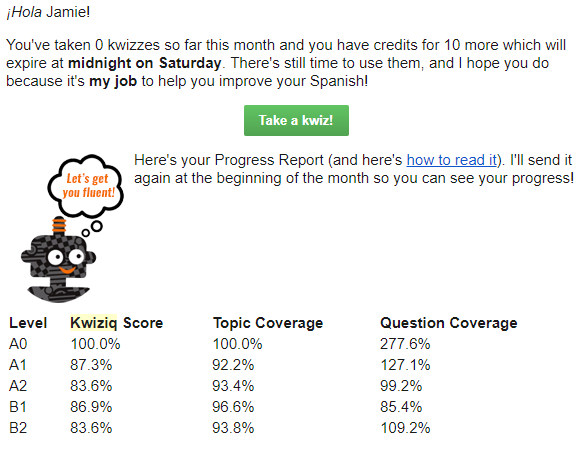
Kwiziq offers 10 free Kwizzes per month to everyone. I love this because the free content never expires! You can take free kwizzes as long as you want, they’re just limited. At the start of the new month, these 10 kwizzes are recharged.

This also means that you get your free kwizzes even if you were a member in the past but have since canceled, which is a thing that a lot of companies punish you for. If you cancel, you’ll still get an email once a month reminding you of free kwizzes that you have left, and when they’ll expire. Even if I’m not paying anymore, I still really like to be informed of free content that’s waiting for me.

Kwiziq review

Con: You can get a lot more for free elsewhere

Kwiziq isn’t the only guy out there with free quizzes to test your grammar fluency, but they’re the only one I know about that limits their quizzes. They are in competition with a couple of other resources that offer very similar products, with very similar information, all for free.

For example, Spanishdict is a great website with a free online Spanish-English dictionary, forum, and similar quizzes. These quizzes aren’t led by artificial intelligence, but they do a great job of providing you with the practice for some of these more difficult concepts.

Another popular free resource for grammar quizzes is StudySpanish. This website also has significant amounts of information available to help you understand your grammar, with some more hidden behind a paywall.

Note that both of these options are Spanish only. I’m not aware of similar resources for French as of this Kwiziq review.

Con: Kwiziq might be out of your budget

While Kwiziq is far from the only monthly membership platform to learn a language, it is on the pricey side. I do think the value is absolutely worth the price if you can swing it, and you specifically need to improve your grammar.

You can click here for Spanish pricing, and here for French pricing.

But don’t leave this Kwiziq review yet, there are still important features to talk about!

Pro: Kwiziq is more than just grammar

Primarily, Kwiziq is perfect for improving your Spanish and French grammar, but the other exercises in the “library” are excellent as well.

Just like Kwiziq’s grammar content, the exercises are also organized by A1-C2, so you get a really solid, in-depth understanding of your skill levels across the board, considering all 4 are rarely in the same place at any given time. And, honestly, I highly recommend Kwiziq for all language learners, if even just for these exercises.

In those practices (especially the last one), I love that it has you grade yourself. This is more flexible than the normal kwizzes, so you don’t have to mark yourself wrong for not seeing a word if you don’t find that necessary.

Then, of course, Kwiziq then links you to the individual lessons used in the statement, so you can figure out what you did wrong. If you’re not up to doing that research just yet, the icons to the right of the lesson links let you save them for later.

Still not quite getting it? All users are able to comment on the lessons and ask their questions, and Kwiziq’s Spanish teachers are actually incredibly responsive; if you’ve found something ambiguous and your question helps them see that something is confusing, they also have the power to make changes.

Plus, you can’t forget about the Weekend Workout! Every weekend, members get brand-new writing and listening challenges appropriate for every level sent directly to their email. It’s honestly a really nice reminder to keep up your practice, even if it’s only a little bit.

Kwiziq review: how to know if it’s the language app for you

At the end of the day, this Kwiziq review shows us a really great resource for French and Spanish learners. It has every grammar concept under the sun, and more are being added regularly.

Its gamification and easy-to-swallow kwizzes are addictive, which means that you’ll learn more grammar than you ever would anyways (let’s be real, most of us hate learning grammar). The exercises that are updated regularly are also a major win, I think.

If you’re not looking for grammar help, Kwiziq’s price point may not be worth it for you, depending on how much you use the other exercises. If you’re looking for something similar at a lower price point, I would recommend Yabla instead – not as pretty or user-friendly, but has similar types of exercises.

After reading this Kwiziq review, I would recommend all Spanish and French language learners, no matter the level, at least go through a few free kwizzes (click here for Spanish, or click here for French) and have the AI assess your level.

Filed Under: $101-200, $16-20, Advanced, Annual subscription, Audiobooks & video, Beginner, Communication, Daily streaks, Device, Explicit, Free, French, Gamification, Grammar, Implicit, Intermediate, Language app reviews, Language Skill, Level, Listening, Monthly subscription, Other Features, Pricing type, Reading, Spanish, Spelling, Stories, Target Language, Website, Words/phrases, Writing

Rosetta Stone review: for beginner language learners only

March 21, 2022 by Jamie Leave a Comment

Rosetta Stone has been a major name in the language learning world longer than most. This Rosetta Stone review will help you decide if it’s the language app for you.

Can you really get fluent using Rosetta Stone? Is it worth the money? Should you be considering it? In this Rosetta Stone review, I’ll touch base on all these questions, so you can make an educated decision on whether to take the plunge.

First things first, though, is to make sure Rosetta Stone actually teaches the language you’re interested in learning. Rosetta Stone offers the following languages:

  • Arabic
  • Chinese (Mandarin)
  • Dutch
  • English (American)
  • English (British)
  • Farsi (Persian)
  • French
  • German
  • Greek
  • Hebrew
  • Hindi
  • Irish
  • Italian
  • Japanese
  • Korean
  • Latin
  • Polish
  • Portuguese (Brazil)
  • Russian
  • Spanish (Latin America)
  • Spanish (Spain)
  • Swedish
  • Tagalog
  • Turkish
  • Vietnamese

Rosetta Stone review: what works

First off, let’s talk about how exactly Rosetta Stone accomplishes what it says it will accomplish. I’m very particular about making sure I’m practicing all of my language skills and knowing exactly what my goal is with any language.

That being said, how does Rosetta Stone work, and what does it teach you?

The closest thing to immersion

Rosetta Stone’s claim to fame is that it teaches you the language by immersion, which is great! And it’s true – you will never see or hear a single English word using this program. Using Rosetta Stone as an ultimate beginner is great because you’re learning to think using the language right off the bat; compared to other programs, where you’re translating between languages in order to learn, this is undoubtedly the best way to take in a language.

And Rosetta Stone is great for this very reason: it makes you think. With every round of questions, the way it’s designed forces you to actually think in the language. This is the first step in learning a new language authentically and efficiently.

So, if you’re starting out with the language fresh and new, the Rosetta Stone method is incredibly challenging, but in the best way.

The lessons may not go by as quickly and painlessly as Duolingo’s 5-minute lessons – you’ll spend a significant amount of time really using your brain, just like you would in real-life immersion. In fact, I had to take a break after the first 2 lessons because my brain hurt like it does when I’m in actual language exchanges!

Multiple-choice questions that you can’t fake

Another thing about Rosetta Stone that I really love is that you can’t really BS it. The program depends heavily on multiple-choice questions, but they switch it up. For example, you’re given a phrase, and then you’re given 4 pictures – your job is to match the phrase to the correct picture.

Once you’ve done that, not only is the text taken off the picture (so you still have four images to choose from for the next phrase), but the order of the pictures is flipped around. It’s just another level at which you actually have to think, as opposed to “well I’ve already matched up 3 pictures, so I don’t even have to look at the last phrase to know which picture it belongs to”.

It’s a simple thing, but it really makes a world of difference when it comes to making you actually think in the language, which, again, is one of the most important parts of effectively learning a new language.

Speaking from the beginning

Another thing that Rosetta Stone does really well is making you speak from day one. At the beginning levels, this is really helpful, as a lot of newbie language learners don’t realize that getting used to forming the words correctly is a skill in itself.

Foreign languages use different sounds, and just recognizing them by ear isn’t enough – you need to build muscle memory, and Rosetta Stone helps with that.

Rosetta Stone makes very large claims about speech recognition. I personally tend to take this with a grain of salt, because this isn’t the first time I’ve heard that, and it’s usually pretty useless. Most of the time, speech recognition is either easy to fake or says you’re wrong even when you’re right.

In my experience…Rosetta Stone’s speech recognition is about 50/50, as well. In some ways it has alerted me to how I’m pronouncing incorrectly, but whether or not it’s been a convenient fluke…who knows. I say that because after saying the same word with the same exact pronunciation four times and being told it was wrong the first three and right the fourth…it’s still not 100%.

So, take what it tells you with a grain of salt. Listen carefully, and absolutely practice your speaking, but I feel like there are better ways to go about that one.

…and all the other language skills

Yes, speaking is the big thing that most newbie language learners might avoid. Besides speaking, Rosetta Stone is surprisingly good at hitting the other language skills: reading, writing, and listening. Once you get through your core lesson, where you’ll learn all the things you need to learn about that unit, you’re also taken through lessons for each individual skill, which is amazing.

You get all of your language skills, appropriate to your level of learning, right in one go. Honestly, no other independent language learning resource does that, so in this way, Rosetta Stone is way ahead of the game (and has been for more than 20 years now).

That being said, this is a big deal. From the very very beginning, you get in the habit of practicing the language in every way necessary. Pretty good for beginners!

Rosetta Stone review: what doesn’t work

Now that I’m done raving on and on about how wonderful Rosetta Stone is, let’s talk about its failings. Now, keep in mind that it’s not that this program does things wrong necessarily – Rosetta Stone knows who its target audience is, and if these faults are a big deal, it’s not meant for you anyway.

I say this because I’ve seen plenty of reviews talking about how Rosetta Stone is heavily flawed, but so is every other language learning resource. Nothing is one-size-fits-all; if it were, there wouldn’t be a reason for all of these products. Know what you’re looking for in your language learning journey, and that will help you to make the right choice.

It’s repetitive

Right off the bat, Rosetta Stone can get infuriatingly repetitive. If you’re used to learning languages, and it’s easy for you to grasp linguistic patterns, Rosetta Stone is horribly boring and slow. The most basic words and grammatical patterns don’t need to be drilled so incessantly for learners who have already learned these same exact patterns in other languages.

If you’re an ultra-newbie this is great, because you’ll learn the basics and you’ll learn them well. However, if you’ve already done the legwork to recognize and be familiar with these basic patterns, you’re gonna get real bored real quick, which means you’ll give up.

Even with more advanced-level content, this was too slow. I tried to go into the settings real quick to speed it up, but no-go.

Rosetta Stone will provide you with a great base level to build on, which is great if you need it. If you don’t need it, don’t bother with it.

It’s basic

Rosetta Stone has 5 units of lessons for languages that are related to English, but only 3 or 4 for other unrelated languages. There is a lot of content, and the content is very thoroughly broken down into all of the language skills. It involves a lot of drilling and a lot of basic hand-holding.

However, the amount of drilling and hand-holding involved means that the content doesn’t get you very far. If you’re planning a trip abroad and want to feel comfortable understanding and communicating at a basic level, it’s very thorough and efficient. However, you won’t get much farther than that. And if you’re a seasoned language learner, you’re gonna get bored real quick, even if you’re still learning things.

You will not be learning intermediate or advanced words or concepts with Rosetta Stone. If you’re just starting out with the language, you’ll be fine, but there is no real building on the basics using this program. You’ll get a very solid root to the language, and you’ll be at a good place to push onward, but you can’t get onward depending solely on this program.

It’s expensive

This has been a major sore spot for Rosetta Stone since the beginning. Especially since the internet became a thing, and a variety of cheap or even free resources have become available, the steep price tag (think $200 for a single-level CD-set!) has turned a lot of people off.

As time has gone on, Rosetta Stone’s prices have become a bit more palatable by switching to a monthly model like a majority of the industry. The caveat is that you cannot invest month-by-month. You can see current prices here.

Fortunately, they do offer a 30-day guarantee.

Rosetta Stone review: stories

With stories, you get 3 different options for practice: read the story, read and listen, or read and read aloud. These stories are very on-level, and offer you another resource to practice both input and output.

I’m a big fan of listening to text while you read it, plus highlighting each individual word as it’s read? Two thumbs up!

When reading aloud with the story, the concept is exactly the same – the highlight tries to follow along with you word-by-word. It’s not exactly 100%, but it does the job enough.

Use this tool to listen to how you’re pronouncing the words, and then switch back to listening to compare.

My only complaint here is that I wish you had the option to download your recording. That way you could send it to a tutor or language exchange partner for feedback, or even just keep track of your progress for yourself.

Rosetta Stone’s audio companion

Then we have the audio companion. With each lesson, Rosetta Stone offers audio tracks of vocab pronounced correctly and slowly, with a beat after each word for you to repeat.

On mobile, you have the option to rewind, pause, and fast-forward; on desktop (as pictured), you just get the audio tracks downloaded straight to your device. In this case, it’s up to you to have a program that offers these options.

This first lesson had 18 audio clips (including the intro), by the way, not just the 3 shown here.

Rosetta Stone review: is it for you?

Rosetta Stone is a great language learning program that satisfies every language skill (that in itself is hard to come by), meaning you don’t have to look elsewhere for practice. If you’re a total beginner looking for a very confident base in the language, click here to get started with Rosetta Stone.

However, if you’re not a beginner or find the pace to be much too slow, I’d skip it. Instead, I’d recommend these comparisons if you’re interested in something similar:

  • Babbel vs Rosetta Stone
  • Duolingo vs Rosetta Stone
  • Pimsleur vs Rosetta Stone
  • Babbel vs Rosetta Stone vs Duolingo

Filed Under: $10-15, Android app, Arabic, Audiobooks & video, Beginner, Chinese (Mandarin), Device, Dutch, English, Farsi, French, German, Grammar, Greek, Hebrew, Hindi, Implicit, Intermediate, iOS app, Irish, Italian, Japanese, Korean, Language app reviews, Language Skill, Latin, Level, Lifetime access available, Listening, Monthly subscription, Polish, Portuguese, Pricing type, Reading, Russian, Spanish, Speaking, Speech recognition, Stories, Swedish, Tagalog, Target Language, Turkish, Vietnamese, Website, Words/phrases, Words/phrases

  • Page 1
  • Page 2
  • Page 3
  • Page 4
  • Go to Next Page »

Primary Sidebar

Meet your language coach

Hi! I'm Jamie (she/her), and I help you learn exactly what you need to do to learn a foreign language. Click my face above to learn more about me and how I can help.


We strive to offer equitable access to language learning for all, regardless of ethnicity, gender identity, ability, or sexual orientation.
Copyright © 2025 · Multilingual Mastery · Privacy Policy

  • About
  • Get 1:1 support
  • App search