• Skip to primary navigation
  • Skip to main content
  • Skip to primary sidebar
Multilingual Mastery

Multilingual Mastery

Online language learning coaching & education

  • About
  • Get 1:1 support
  • App search

Jamie

Verbling vs italki for language learners

March 21, 2022 by Jamie 1 Comment

One of the best ways to practice speaking a foreign language is to have conversations with native speakers of the language. The two most popular platforms to connect with native speakers are italki and Verbling. Let’s take a look at Verbling vs italki to see which platform is best for you.

It should be noted that Verbling and italki are very similar platforms, and while they may technically be in competition with each other, it may be best practice for language learners to take advantage of both platforms.

Because as we’ll discover as we compare Verbling vs italki, it’s not so much the platform that matters as the teachers who use the platforms.

Verbling vs italki: teaching experience

Each company has different experience requirements for language teachers who are interested in using their platform to find students. This can also be evident in the student’s search for a teacher.

The most popular option, italki, lets you choose between professional and community teachers. The difference is that a professional teacher has some sort of official qualifications or certifications to teach; community teachers are just native or advanced speakers of the language.

On the other hand, Verbling requires potential teachers to have professional experience. If you’re using Verbling, you’re there to learn, not just to practice.

Is professional experience necessary? If you want the structured approach of a teacher, yes; however, if you just want to pay a native/advanced speaker to be available and help you focus on communication, not necessarily.

And of course, community teachers are much cheaper. Professional experience comes at a premium. It’s up to you to decide if professional experience is a priority, and this will help you decide on which platform to prioritize.

italki vs Verbling: trial lessons

Taking a language lesson for the first time can be a daunting experience, especially when you’re meeting the teacher for the first time, and you’re not quite sure what the atmosphere will be like.

Fortunately, both Verbling and italki offer a version of trial lessons. The approach, of course, is different.

First, italki offers 3 free trial lessons ever. These are tied to your account and must be applied to 3 different teachers if you use them. Not all italki teachers offer free trial lessons, so I’m guessing it’s truly free, which means that the teachers are not paid at all (italki does not pay for these lessons for you).

Verbling is a lot less strict and gives its teachers 100% say in their own trial lessons.

If a Verbling teacher decides to offer a trial lesson, they set the price. With this system, each new student gets to trial the teaching style of any teacher.

Plus, Verbling teachers are paid for their trial lessons. It’s half the time of a full lesson, so they can charge half the price. This is compared to italki, which expects its teachers to offer them for free.

In this way, Verbling is a much better option, both for language learners (who get to trial as many teachers as they like) and for language teachers (who get paid for their time, regardless of how much time they’re spending).

Class types

Both Verbling and italki specialize in private language classes, which means 1-on-1. You’re paying someone to focus on your language learning. There is a little bit of wiggle room, though.

For even more ease of commitment (more on this later), some Verbling teachers offer bulk lessons; if you commit to a number of lessons (5, 10, 20, whatever), you get a small discount.

On the other hand, italki has a small collection of group lessons.

On italki, this is definitely not the star of the show. It simply does not compare to a service like Lingoda that truly excels at this. Based only on first impression, it seems to be a low-stakes way to find your next language teacher.

Though, at the time of this writing, this feature isn’t available in most languages. As I said, it seems to be an option to support more private classes, by making them slightly more accessible to start, as opposed to a formal feature.

Booking a class on Verbling vs italki

The process of booking a language teacher differs between platforms, and this is more important than you may think.

Emotionally, it can be difficult to commit to a lesson with a language teacher. It’s not uncommon to be self-conscious about your ability to have foreign language conversations, worried about financial commitment, anxious about committing to a routine, etc.

That said, it’s the responsibility of the platform to make it easy for language learners to book a lesson. If it’s too difficult to book, that just becomes another obstacle stopping a language learner from committing.

There’s one tiny difference between Verbling and italki here: where the lesson is hosted. italki allows you 3 options: their own software, Zoom, or Skype.

To be fair, I am 100% nit-picking. But at the same time, I am well aware of how tiny things like this can make it feel impossible to do things like schedule a lesson with a language teacher, which can be hard enough as it is.

italki offers 3 different platforms (which I’m assuming invites some technical difficulties when it comes to sharing usernames, Zoom/Skype outages, etc.), while Verbling only uses their own software.

Verbling keeps it simpler. When it’s time for your lesson, all you have to do is go to the website and there will be a link for you to join the classroom, right there on Verbling.

Obviously, I can’t say how reliable it is – that’s something to ask your language teacher with much more experience with the tech than I’ll ever have. But from the perspective of a language learner, this is a much better system.

Which platform is best?

While most online creators will mention italki, I personally find Verbling to be just slightly higher quality for language learners: higher quality teachers, easier to book lessons, and easier to join.

Above all else, as I mentioned at the beginning of this review, is that specific teachers on each platform. While looking for a language teacher, the website they’re on isn’t as important as the teachers themselves, so I encourage you to keep an open mind.

Want to learn more about each platform?

You can read my italki review here, and my Verbling review here.
Filed Under: Advanced, Afrikaans, Ainu, Albanian, American Sign Language, Amharic, Android app, Arabic, Aramaic, Armenian, Assamese, Azerbaijani, Basque, Beginner, Belarusian, Bengali, Bosnian, Breton, Bulgarian, Burmese, Cantonese, Catalan, Cebuano, Cherokee, Chibemba, Chichewa, Chinese (Hakka), Chinese (Mandarin), Conversation, Conversation, Creole, Croatian, Czech, Danish, Dependent on Users, Device, Dutch, Dzongkha, English, Esperanto, Estonian, Farsi, Feedback, Fijian, Finnish, Flemish, French, Gaelic, Galician, Georgian, German, Greek, Greenlandic, GuaranĂ­, Gujarati, Hakka, Hausa, Hawaiian, Hebrew, Hindi, Hokkien, Hungarian, Icelandic, Igbo, Ilocano, Indonesian, Intermediate, iOS app, Irish, Italian, Japanese, Javanese, Kachchi, Kannada, Kazakh, Khmer, Kinyarwanda, Korean, Kurdish, Kyrgyz, Language app reviews, Language Skill, Latin, Latvian, Level, Listening, Lithuanian, Macedonian, Malagasy, Malay, Malayalam, Maltese, Manx, Maori, Marathi, Mongolian, Navajo, Neapolitan, Nepali, Norwegian, Occitan, Ojibwe, Oriya, Oromo, Other Features, Papiamentu, Pashto, Persian, Pidgin (Nigerian), Piedmontese, Polish, Portuguese, Potawatomi, Private, Professional, Punjabi, Romanian, Russian, Saami, Samoan, Sanskrit, Sardinian, Scots, Scottish Gaelic, Serbian, Shangainese, Shona, Sicilian, Sindhi, Sinhala, Slovak, Slovenian, Somali, Spanish, Speaking, Swahili, Swedish, Swiss German, Tagalog, Tamil, Target Language, Telugu, Thai, Tibetan, Tigrinya, Tok Pisin, Turkish, Tuvan, Twi, Ukrainian, Urdu, Uzbek, Vietnamese, Website, Welsh, Wenzhounese, Yiddish, Yoruba

Kwiziq review: fun AND quality grammar lessons

March 21, 2022 by Jamie 1 Comment

Kwiziq is a gamified membership system meant to help French and Spanish language learners understand and conquer grammar concepts, in an intuitive, enjoyable way. In this Kwiziq review, we’ll take a deep dive into what that actually means for you and your language learning.

So, what do we need to know about Kwiziq? Let’s take a deep dive into this website. Is it the right resource for you?

Kwiziq review: how does the AI work?

To date, Kwiziq supports the following languages:

  • French
  • Spanish

Kwiziq’s claim to fame is its artificial intelligence. It uses its AI to determine your proficiency with different grammatical concepts, as well as when to test you on them. The way it tests you feels almost like Anki to me, which is a good thing.

It’s not that it reminds you of these things right before it thinks you’ll forget them, but it really throws one or two concepts at you until you make your way through them and prove that you’re ready to move on to something more advanced.

To master these levels, you take quizzes! The AI determines which concepts you should review, and then offers you quizzes, or “kwizzes”, based on this material. Your mastery of every concept starts at 0% and goes up or down depending on the questions you get right or wrong. As you get closer to 100%, the AI will suggest you move on to an upper level.

Besides the technical stuff, Kwiziq’s grammar is separated into CEFR levels, so both you and Kwiziq know what your actual skill level is: A1-C1, A1 being beginner, and C1 being advanced.

This is a great way to conceptualize your language level based on your knowledge of grammar. Clearly, Kwiziq is laser-focused on improving your grammar and keeping you in the know about what you’ve learned and what you still need help with.

Finally, these levels are presented to you in a progress map (as long as you’re a paid member). A green subject is one that’s been mastered, yellow is in progress, and red occurs when you have performed below 0%. Because the AI wants you to stay above 0%, it advises you not to answer questions if you’re not sure about their answer.

Kwiziq review: all the pros and cons to consider

So, now that you have the basic idea of Kwiziq, is it for you? The next section of this Kwiziq review will address several pros and cons based on my own detailed use of Kwiziq for both French and Spanish.

Pro: Kwiziq provides decent explanations of grammatical concepts

Kwiziq has experienced language teachers who create all of its content, and you can see who has provided this information quite easily. As I said, grammar is hard, and these concepts can sometimes take several different tries to finally get into our brains.

When I found Kwiziq, I was right in the middle of an “I kind of understand the difference, but I generally fumble and fall a lot when I try to use them” phase with the preterite and imperfect tenses in Spanish. Now, Kwiziq’s explanation didn’t really help me a lot. What did help me was their chart for the actual conjugations. Looking at what the ending should be over and over again did help me.

At the end of the day, one person can only do so much. The descriptions of when and how to use these grammar concepts are pretty well-executed, and I wouldn’t be surprised if they help certain ideas to really click for you.

Pro: Kwiziq rewards you for learning

One of the best parts about Kwiziq is that it rewards you for your efforts. It’s completely gamified, which means you get rewarded every time you answer 50%, 75%, 90%, and 100% of the questions pertaining to a certain grammatical concept correctly.

You get little stars after each of these accomplishments, so sometimes you’ll finish a Kwiz with a couple of dozen stars celebrating your success! These stars are also paired with “kudos”, which you get every time you accomplish literally anything.

Past the individual lessons, you’re rewarded for your success in certain levels, as well! Accomplishing certain percentages of success in your level means you’ll get trophies: a bronze shield for achieving 50%, a silver shield for 75%, a gold shield for 90%, and a diamond for 100%.

These also build up on top of each other: the more high-level trophies you win, the more foundational awards you get. For example, the A1 diamond trophy is yours once you achieve a diamond in A0 and gold in A1.

Finally, Kwiziq also rewards you for landmarks. You get your first one after your first kwiz and are continuously rewarded for the number of kwizzes you take in a day. The more kwizzes you take, the more landmarks you achieve, and the more kudos you receive.

Con: Kwiziq punishes you for your wrong answers

The way that Kwiziq’s AI works is that it takes all your answers at face value. Correct questions help you, incorrect questions hurt you, and questions that you don’t answer remain neutral. Therefore, Kwiziq tells you not to guess answers if you don’t know them in every kwiz.

While there’s nothing wrong with telling you that you’re wrong, the thing I don’t like about that is that the whole reward system is based on percentages: once you get a certain percentage right, you get a happy little green color, more stars, more trophies, etc.

However, this means that the more times you answer a question incorrectly, the more you have to get it correctly to get all these rewards. Which makes it almost impossible to reach milestones for concepts that may be more difficult for you.

This conflicts with one of my own philosophies for motivation: trying and failing are better than not trying at all. If you don’t try, how do you know if you’ll succeed? Kwiziq punishes learners for this.

Personally, it introduces more anxiety into my brain than is necessary because it means I’m constantly second-guessing whether I actually know the thing that I think I know. It means that I’m never confident in myself because the risk is so extreme.

The whole premise of Kwiziq feeds off a reward system, but if you’re having a hard time understanding something, forget about getting rewarded for practicing that concept, because you’re just never going to get that star. Which means I’ve honestly given up on certain parts of Kwiziq. I didn’t like how much negative reinforcement I was getting – I was being punished for trying!

Pro: Kwizzes are short, 10-question, multiple-choice exercises

The thing about Kwiziq is that it’s addictive. You get rewarded for almost every kwiz you take, and kwizzes are only a minute or so long. You don’t have to commit any time whatsoever to this fun little game. It’s easy to, once you go down the rabbit hole of figuring out your grammar, but you can just take 30 seconds to practice.

Plus, the fact that they’re multiple-choice (at first) makes them significantly easier to swallow. When you’re learning these things at first, you only have to choose from a few different options.

They’re not just 10 questions about 1 concept, either; they’re 10 questions on 2-3 concepts that the AI thinks you should be practicing.

Once Kwiziq’s AI thinks that you’ll be able to do it, it’ll throw you a few fill-in-the-blanks. These are the ones you have to be careful with, though, because it doesn’t take too kindly to typos. One mistyped letter, and you throw away the whole question, even if you were right.

As you can see, these questions get tough! These are things that you don’t necessarily need to know for conversational use of the language, so don’t get hung up on them if you’re not taking some sort of assessment.

Con: No mobile app for this Kwiziq review

We all love to do everything mobile. Especially with Kwiziq’s quick little quizzes, it should be fun to whip your phone out every once in a while, and kwiz your way through some Spanish practice! At least, that’s what I would love to do during a boring movie or something.

Unfortunately, as of this Kwiziq review, there is no mobile app. You can open the website on a mobile device, but it’s not the best – it’s too easy to accidentally hit the wrong multiple-choice answer, you have to keep scrolling to see the full sentence, etc.

Pro: Instant gratification

A great part about Kwiziq is the fact that you can instantly get an explanation as to why they marked your answer incorrectly. At the result of every quiz, they give you links to the lesson page, so you can figure out what you did wrong (or, in some cases, which grammatical concept they were even testing!).

This is an easy way to fill those little gaps in your grammar brain instantly, as opposed to creating a list of things that you should look up, and then you kind of forget what you did, and then you have to find the question again and figure out how to answer it, and it just goes on and on.

Even if I do think that Kwiziq punishes you too harshly for failing (as I believe failing should just mean that you put the effort forward, not “bad language learner, you were wrong”), I do appreciate the ability to get a question wrong and then instantly be directed to the lesson page for a quick reminder.

Con: if you take a break, don’t get anything wrong

Even though Kwiziq’s robot tells you not to answer questions if you’re not completely sure, there is a scenario in which this is different. I ran into this situation when some new topics had been recently added to the A1 level, which brought my 90+% down to somewhere in the 80s. All I wanted to do was get some questions right on this new subject so that my percentage would go back up to the 90s. It was all basic Spanish concepts, so I knew that I already understood them.

When I went to take a new quiz, I avoided all the other questions; I didn’t want to commit the brain space to the other subjects, just the one where I wanted to up my percentage. According to Kwiziq, I wouldn’t be punished for not trying to answer. Unfortunately, I was wrong.

I was on a beginner quiz, and I got all those questions wrong! Which, of course, brought my entire percentage farther down. Didn’t even matter that I got that one question right, the one that had been at 0%. All my little green areas quickly turned yellow, because Kwiziq had just assumed that I had forgotten all those beginner concepts.

Moral of the story: either stick with your kwizzing, make sure you answer all your old questions or don’t pay too much attention to that percentage. If the AI assumes that you forgot something, it will bring your score down to encourage you to relearn those lessons. I get what they’re trying to do, but they should’ve given me a big red flag saying “hey, our rule about not trying to answer questions that you don’t know doesn’t apply anymore, I will judge you on everything!”.

Pro: Kwiziq’s free trial

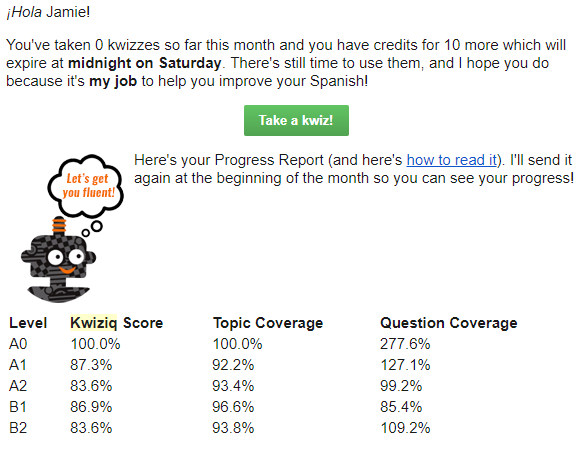
Kwiziq offers 10 free Kwizzes per month to everyone. I love this because the free content never expires! You can take free kwizzes as long as you want, they’re just limited. At the start of the new month, these 10 kwizzes are recharged.

This also means that you get your free kwizzes even if you were a member in the past but have since canceled, which is a thing that a lot of companies punish you for. If you cancel, you’ll still get an email once a month reminding you of free kwizzes that you have left, and when they’ll expire. Even if I’m not paying anymore, I still really like to be informed of free content that’s waiting for me.

Kwiziq review

Con: You can get a lot more for free elsewhere

Kwiziq isn’t the only guy out there with free quizzes to test your grammar fluency, but they’re the only one I know about that limits their quizzes. They are in competition with a couple of other resources that offer very similar products, with very similar information, all for free.

For example, Spanishdict is a great website with a free online Spanish-English dictionary, forum, and similar quizzes. These quizzes aren’t led by artificial intelligence, but they do a great job of providing you with the practice for some of these more difficult concepts.

Another popular free resource for grammar quizzes is StudySpanish. This website also has significant amounts of information available to help you understand your grammar, with some more hidden behind a paywall.

Note that both of these options are Spanish only. I’m not aware of similar resources for French as of this Kwiziq review.

Con: Kwiziq might be out of your budget

While Kwiziq is far from the only monthly membership platform to learn a language, it is on the pricey side. I do think the value is absolutely worth the price if you can swing it, and you specifically need to improve your grammar.

You can click here for Spanish pricing, and here for French pricing.

But don’t leave this Kwiziq review yet, there are still important features to talk about!

Pro: Kwiziq is more than just grammar

Primarily, Kwiziq is perfect for improving your Spanish and French grammar, but the other exercises in the “library” are excellent as well.

Just like Kwiziq’s grammar content, the exercises are also organized by A1-C2, so you get a really solid, in-depth understanding of your skill levels across the board, considering all 4 are rarely in the same place at any given time. And, honestly, I highly recommend Kwiziq for all language learners, if even just for these exercises.

In those practices (especially the last one), I love that it has you grade yourself. This is more flexible than the normal kwizzes, so you don’t have to mark yourself wrong for not seeing a word if you don’t find that necessary.

Then, of course, Kwiziq then links you to the individual lessons used in the statement, so you can figure out what you did wrong. If you’re not up to doing that research just yet, the icons to the right of the lesson links let you save them for later.

Still not quite getting it? All users are able to comment on the lessons and ask their questions, and Kwiziq’s Spanish teachers are actually incredibly responsive; if you’ve found something ambiguous and your question helps them see that something is confusing, they also have the power to make changes.

Plus, you can’t forget about the Weekend Workout! Every weekend, members get brand-new writing and listening challenges appropriate for every level sent directly to their email. It’s honestly a really nice reminder to keep up your practice, even if it’s only a little bit.

Kwiziq review: how to know if it’s the language app for you

At the end of the day, this Kwiziq review shows us a really great resource for French and Spanish learners. It has every grammar concept under the sun, and more are being added regularly.

Its gamification and easy-to-swallow kwizzes are addictive, which means that you’ll learn more grammar than you ever would anyways (let’s be real, most of us hate learning grammar). The exercises that are updated regularly are also a major win, I think.

If you’re not looking for grammar help, Kwiziq’s price point may not be worth it for you, depending on how much you use the other exercises. If you’re looking for something similar at a lower price point, I would recommend Yabla instead – not as pretty or user-friendly, but has similar types of exercises.

After reading this Kwiziq review, I would recommend all Spanish and French language learners, no matter the level, at least go through a few free kwizzes (click here for Spanish, or click here for French) and have the AI assess your level.

Filed Under: $101-200, $16-20, Advanced, Annual subscription, Audiobooks & video, Beginner, Communication, Daily streaks, Device, Explicit, Free, French, Gamification, Grammar, Implicit, Intermediate, Language app reviews, Language Skill, Level, Listening, Monthly subscription, Other Features, Pricing type, Reading, Spanish, Spelling, Stories, Target Language, Website, Words/phrases, Writing

Anki review

March 21, 2022 by Jamie Leave a Comment

Vocab and conjugations are two of the most important parts of any language learning strategy – without them, there is no way you will ever be able to communicate in the language of your choice. They can also be some of the hardest because so many of us have been traumatized by having to learn flashcards in school.

Fortunately for us in the digital age, the internet has come up with flashcard apps that are significantly better for actually learning the stuff we want to learn because they use something that we just can’t get with physical flashcards: spaced repetition software. My personal favorite flashcard app for language learning is Anki, and I think you’ll agree with me by the end of this Anki review.

What is spaced repetition software?

First off, to understand what’s so special about Anki, as opposed to just normal flashcards (besides saving trees), we need to address spaced repetition software. It’s a super important factor in language learning that will honestly transform the way you get new vocabulary into your brain.

So, we all know how flashcards work: you put your hint on one side, the answer on the back, and flip them over to see if you’re right or wrong. If you’re smart you’ll put the easy words in a separate pile from the harder words so you don’t have to waste your time on them, but most of us aren’t.

Spaced repetition software does that little step for us and so much more. It’s an algorithm that separates your flashcards into categories of how easy they are for you to recall. For the flashcards that you can remember pretty much immediately, spaced repetition software will stick them away and hold onto them for you; more difficult terms will be shown to you more often until you can consistently recall the information.

Anki review

Then, as time goes on, the spaced repetition software will judge when you’re most likely to forget your terms and shows them to you just before you forget. This way, it helps bring your vocabulary from your short-term memory to your long-term memory, without wasting your time by showing you the words you already know as often as the more difficult ones.

While spaced repetition isn’t unique to Anki, the visible time frames are; sure, LingoDeer’s self-reporting SRS is much more beautiful, but it doesn’t tell you how long it’ll be before you see the term again!

For language learners, spaced repetition software is a game-changer. We’re learning thousands of words per language – nobody has the time to review all of them every day, nor do we have the brain space to keep track of when we should be reviewing each individual term. Thanks to spaced repetition software, we don’t have to do anything more than telling it how easily we remembered the card.

Anki review

So, with the basic idea of spaced repetition software in mind, let’s continue to the Anki review. Let me preface by saying that while Anki isn’t the prettiest program on the block, it works. Anki is the spaced repetition software most commonly used by language learners, and it’s for good reason.

To start off:

  • Yes, it’s free (only on Android, though. iPhone users have to pay. Sorry!)
  • Yes, it’s both on desktop and mobile
  • No, you don’t have to choose between the two: you can sync all your lists to Anki’s database at any point

Anki cards

Anki has its own lingo for the flashcards you create: the terms themselves are Anki cards, and the individual lists of terms are Anki decks.

When you make your Anki cards, the first option you’ll see is to select the type of Anki card. This defines how your vocab is presented to you, and you can use this for a whole bunch of things: learning to recognize vocab, learning to spell it, or even learning to fill in the blank. Anki does this with the following options.

Anki review

Basic Anki cards

If you don’t define your type of flashcard (which is completely okay), Anki will select a Basic Anki card for you. This is your run-of-the-mill flashcard maker: you put your vocab word on the front and put the answer on the back. Flip the card over to see your answer and whether you were right or wrong.

With Basic Anki cards, you also have the option to switch the cards from back to front; you can do this for more of a challenge, since it forces you to actually learn the word in your foreign language, instead of just kind of recognizing the first few letters of your new vocab.

Basic (and reversed card) Anki cards

Next, we have basic and reversed Anki cards. When you choose this option, you’ll get two Anki cards for every card that you create – one will be the card you create, and the other will have the back for the front and the front for the back.

This is a good way to not only reinforce the vocabulary you’re learning by reviewing it twice, but you’ll also learn to associate your new word with your English word by creating that link in your brain. Do keep in mind, though, that because you’re doubling your Anki cards, you’ll spend twice the time reviewing, which may not be the most efficient, especially for more simple vocab.

Anki review

Basic (optional reversed card) Anki cards

Fortunately, Anki recognizes that the reversed card option might not be efficient for every single one of your flashcards, so they also give you the option so you do not have to flip back and forth between types of Anki cards.

As you can see, this type of note has three fields; the first two are for the flashcard itself, and the third field is where you let the app know whether or not you need the reversed card. If you don’t, leave it blank. If you do, don’t leave it blank; it doesn’t matter what you put in the field, and, honestly, I feel like it should be a check box, not another field. Nonetheless, it is convenient to have this option as opposed to constantly flipping back and forth.

Basic (type in the answer) Anki cards

This type is my favorite. It’s important to me to know how to spell my words because it not only makes my knowledge of my vocab more specific, but I’m also practicing how to write the word, which helps me later on when I’m practicing my writing.

This option looks the same as the Basic notes. You won’t see the difference until you actually go to review your vocab, at which point you’ll be asked to spell out the other side of your flashcard, as opposed to just flipping it over.

Cloze Anki cards

Finally, we have the Cloze Anki cards. This option is less for learning vocabulary and more for practicing quizzes and how to complete sentences, which is also helpful. This is a great tool for learning conjugations, for example.

Anki review

Cloze Anki cards removes a word or phrase out of a sentence. Your job is to fill in the blank. So, for example, you can use this as a fill-in-the-blank for verb tenses (because we all know how annoying those are to learn):

Types of answers in Anki cards

On top of all these different types of Anki cards, we can also switch up the media type. Besides just typing in the words, we can use our Anki cards to upload an image or record audio. I mean hey, the more options we have in taking in our new vocabulary the better, amirite?

I personally really love the audio option, because it helps me to train my ear for listening. Being able to read the word is only half the battle – I need to learn to hear and say the word, too! This is great, especially for brand-new languages, when you’re not used to the sounds just yet and need them consistently reinforced. You can opt to hear the pronunciation every time you see the word, which is incredibly helpful for taking it in.

While the option to upload an image isn’t personally helpful for me, it can be very helpful for a couple of reasons. First of all, this can really help with connecting the new vocabulary with the concept, as opposed to just the translation (we all need to learn how to think in our languages, not just translate them!).

Anki review

Second, because you have the option to both upload an image you’ve already found online and take a new picture with your camera, you can connect vocabulary with the things you see every day; for example, pair a picture of your computer at work with the word for computer in your target language. That, my friends, is called immersion.

Suffice to say, Anki provides you with a variety of methods to learn your vocabulary. Because this option is in the same table where you create your notes, you can create an entire Anki deck with any and all of these types of cards, which can really mix up your practice, keeping it interesting.

Anki shared decks

If you’re not interested in creating your own Anki decks and find it easier to go off what others have used, another option is using Anki shared decks. They’re exactly what they sound like – Anki decks that someone has created and stuck online for the purpose of helping other people who want to learn the same things.

There are, obviously, pros and cons. While finding the right Anki shared decks for you might be easier than creating your own, you do need to take them with a grain of salt. Anybody can put up anything, so there is the possibility of what you’re studying being wrong. Also, since you’re not creating these Anki decks yourself, they’ll be harder to learn; I always say it’s best to learn new vocabulary and concepts from context.

If you’re new to Anki decks, though, I do suggest at least taking a look. You can see how others have used the platform and can get inspiration for the possibilities of Anki, as opposed to just using it as a basic flashcard maker and missing out on all the tools available to you.

Anki app vs Anki desktop

When you first go about making your Anki account, you’ll get a message suggesting you start out on desktop; apparently, it’s meant to be primarily a desktop program, and the Anki app exists mostly for convenience. Never fear, I use the Anki app almost exclusively and have not had any problems.

While the Anki app is almost exactly like the desktop program, there are a couple of small differences. For example, the desktop program gives you more freedom to edit the HTML of your Anki decks, which is nice, but not something that is usually important to language learners.

Anki review

The desktop program does also give you a few more opportunities for personalizing your Anki decks. You can change colors, bold/italicize/underline the text, and go into exponents. This could be helpful for your memorization, so if colors work for you, please start out on the desktop program. But, otherwise, if you don’t even have a computer, the Anki app will work just fine for you.

How to use Anki for language learning

As you can see, the Anki decks in the Anki app are a really amazing tool for language learners. You can learn vocabulary, conjugations, practice listening, spelling, upload images, and have a computer figure out when the best time to show you each Anki card. It’s honestly one of the best resources for language learners, in my humble opinion.

And, as the Anki website states, please make sure you look around the program to figure out how to use Anki in a way that will work for you. I mean, plain, basic text flashcards are helpful, but you can really use Anki to your advantage to cement the things you’re trying to learn into your brain.

Decide how to use Anki for yourself, and I promise you’ll never look back. The way you learn your vocab will go from an overwhelming number of flashcards to a well-rounded review of what you need to review and nothing else.

Filed Under: Language app reviews

HelloTalk review

March 21, 2022 by Jamie Leave a Comment

Without a doubt, immersing yourself in a foreign language is the best thing anybody could ever do for their language learning. It can be hard to find immersion in a foreign language, though, especially when you don’t have the time, money, or flexibility to go abroad.

Fortunately, there are workarounds like the HelloTalk app. HelloTalk is basically an app built specifically to foster texting combined with a language exchange. This makes HelloTalk a great option for serious language learners who want immersion but just can’t have it.

So let’s talk about it: the strengths, weaknesses, and what you can expect. In this HelloTalk review, we’ll see if this app can help push your fluency forward and meet your language learning goals. What does the HelloTalk app have to offer, and where does it fail? Is it the right app for you?

HelloTalk review: the lowdown

Okay, so the HelloTalk app is like a constant language exchange over text, but what does that mean? How does it work? Well…it’s actually pretty great. The folks over at HelloTalk really seem to understand what goes into language learning, because they’ve built the app to offer the tools to suit almost any language learner.

HelloTalk review: use it on your break!

The HelloTalk app isn’t just another texting app that connects you with other language learners. It also has a whole bunch of tools specifically made to help you refine your communication skills in your chosen language. It’s almost like a texting app on steroids…except more healthy and not cheating.

Basically, you should look at the HelloTalk app as a kind of international social media made specifically for language learners, which is awesome! Honestly, it can be difficult to find a good, dependable language exchange partner, and HelloTalk provides a low-key, low-stress alternative.

The biggest issue, at least the biggest issue that I’ve found, with language exchanges is getting your language partner to show up in the same place and the same time as you. Life happens so it can get really, really difficult. With HelloTalk, you just need your phone! So let’s jump right into the specifics of this HelloTalk review with explaining how the HelloTalk app is organized.

Talks

Once you have an account and have selected your language and all that good stuff, it’s time to talk! This first section will be empty at first, and it’ll fill in with all the conversations you find. Really, it’s just like any other texting app you’ve ever used, which is easy.

Once you have these conversations started, HelloTalk provides a variety of ways to converse. I personally love this, because not only can you practice a variety of methods of communicating, but it also gives you options depending on your learning style. Unlike most language learning resources out there, you can practice more than just 1 method of communicating – you can practice them all if you can find someone willing!

So, while you can obviously just text, you can also send and receive audio, pictures, doodles, and even have a video chat! This is seriously awesome because you can get all of your language skills in one shot: reading, writing, listening, and speaking. No other language learning resource works quite so efficiently, so kudos!

HelloTalk review: corrections

You don’t need to find someone and then ask them for their Skype and then find them on Skype and then get them to add you and then talk about what time you’re available and then hope that there are no technical difficulties, but of course, there are, so you need to take a rain check, and then you never hear from them. No. You just find someone and ask for a video chat. Easy.

What’s more, is the corrections. As long as you find someone to talk to who will take the time to correct you, you can have all of your mistakes corrected in real-time, which is awesome! HelloTalk makes it really easy, too – when you make corrections, you can put the incorrect text in a red font, and write out the correction in a green font. Seriously, seriously helpful for visual learners, and everyone trying to learn how to write correctly in their language.

And that’s a big deal, because finding someone to talk to isn’t necessarily the hard part. I mean, you could get a journal and talk to yourself about your own life! But it’s less easy to find a native to correct your mistakes and help you out.

Moments

After the section with all of your actual conversations is Moments. This is basically a language-wide forum where you can put yourself out there and solicit conversations, or just check out what everybody else is posting. You’ll only see posts by those who are learning your language and speak your desired language, so it’s a cool way to find more language exchanges, and even already have something to talk about.

HelloTalk review: the moments tab

Then, in that same Moments tab, you’ll see Help Others. It’s pretty self-explanatory: members have questions in your native language, and you can answer them. Again, a good way to find someone to exchange languages with, so long as you’re up to making some corrections.

In my opinion, this is the best way to go about it; if you’re willing to make corrections, you’ll likely find someone who is also willing to correct you, as opposed to finding someone who just gets the basic idea of what you’re trying to say (which, you know, there’s nothing wrong with that, but it’s just not optimal).

And, of course, you can post your own stuff on this forum. It doesn’t even have to be language related! HelloTalk is more than welcoming for literally any inspiration you find to either try to communicate in the language you’re learning or provide more practice for others.

It’s pretty cool – you can talk about just about anything with just about anybody! Talk about travel, your life, current events, your hobbies…literally anything and everything. Starting conversations is good!

Search

Alright, Search is where you’ll generally find your actual language exchanges. In this tab, you search through all of HelloTalk’s members that speak the language you’re learning and are learning the language you speak. They’re organized by how recently they’ve been online, so you can find more active members. (By the way, if you start conversations and then just don’t ever open the app again, you lose all of your past conversations.)

Right off the bat, you see a list of language learners: their names, their country (which can be important when it comes to accents/dialects), a picture of them, when they were last online, and their skill level in the language they’re learning. Really, just go down the list and pick someone who jumps out at you. There are no rules for this! You can even just message a whole bunch of people and go off of who responds.

HelloTalk review: the search tab

Once you click onto a profile, you’ll get some more information about them and their activity on the HelloTalk app. Everybody has the option to provide a self-introduction, and you’ll also see their local time, gender, age, and basically a social media scroll of their Moments. Depending on how much they’ve put in their profile, you might be able to learn a thing or two about them and find someone who you have something in common with.

This is when I do have to make a note to the women out there: you will get inundated with men wanting to talk to you. Doesn’t matter what you look like, what you sound like, or any of that. You will get an avalanche of messages from men.

You can choose who you talk to and who you don’t, but, in my experience, the only members I’ve found who were actually interested in exchanging languages were women. Nothing wrong with choosing to respond to these men at all – you do you, boo! I’m just making the statement that it happens.

BUT. Outside that, if you’ve found someone you think you might want to have a language exchange with, message them and say hi! Or hey, if their Moments are particularly interesting, you can always just opt to follow them. There are no rules to this! Also, this is the tab of the HelloTalk app where you can block someone in case you need to. Like I said, it’s like social media for language learners.

Learn

Finally, we have the Learn tab. This is where you can switch languages, or you can find discounts on whichever language course they’re recommending to you. It’s entirely up to you whether or not you buy it – I’m sure HelloTalk is getting some affiliate income on the side.

HelloTalk review: the learn tab

If you’re a free member you can switch languages, but then you lose everything in your current language. With their new VIP membership, you can learn up to 3 languages at a time. If that’s your jam, it’s honestly not a bad deal – only $5 a month! That would be pretty overwhelming for me, but if that’s how you like to live your life, toss them a few bucks! I’m always happy to support the people who provide the language learning community with useful products.

HelloTalk review: is it right for you?

If you couldn’t already tell from this HelloTalk review, I have a pretty glowing opinion of the HelloTalk app. I personally think it’s a really great resource that provides a lot of opportunities for language learners and aspiring language learners around the world. I think that it’s executed well, and I will happily recommend it to anybody who asks. Plus, they advertise offering 100+ languages, which is crazy! There’s almost no reason why you shouldn’t be able to find the language you’re learning.

HelloTalk review: if you're already on your phone anyways, use the HelloTalk app

But is it right for you? Yeah, I love this app. Yeah, I think it can help a lot of people. But do I personally use it? Nope. It’s a great idea, but it’s just not for me. I’ve tried it a few times on and off, and I really do love the idea, but let’s face it: I hate answering the phone! Hearing my phone go off all the time is really stressful to me, and then I feel guilty about starting conversations and then just disappearing. But that’s just me.

It’s such a random thing to get in the way of my language learning, but it doesn’t work for me. And if this kind of thing wouldn’t work for you, there’s nothing wrong with that. If your phone is always in a different room, if your friends generally have a hard time getting in touch with you…the HelloTalk app won’t work for you. You have to be pretty attentive to your phone if you’re going to be trying to have these conversations because, unfortunately, it’s only an app. There’s no desktop version available.

But if you’re always on your phone? I highly, highly, highly suggest giving the HelloTalk app a go. It can be hard to find a native speaker to correct your writing, so I would take full advantage of this resource if answering your phone doesn’t stress you out.

Filed Under: Language app reviews

Rosetta Stone review: for beginner language learners only

March 21, 2022 by Jamie Leave a Comment

Rosetta Stone has been a major name in the language learning world longer than most. This Rosetta Stone review will help you decide if it’s the language app for you.

Can you really get fluent using Rosetta Stone? Is it worth the money? Should you be considering it? In this Rosetta Stone review, I’ll touch base on all these questions, so you can make an educated decision on whether to take the plunge.

First things first, though, is to make sure Rosetta Stone actually teaches the language you’re interested in learning. Rosetta Stone offers the following languages:

  • Arabic
  • Chinese (Mandarin)
  • Dutch
  • English (American)
  • English (British)
  • Farsi (Persian)
  • French
  • German
  • Greek
  • Hebrew
  • Hindi
  • Irish
  • Italian
  • Japanese
  • Korean
  • Latin
  • Polish
  • Portuguese (Brazil)
  • Russian
  • Spanish (Latin America)
  • Spanish (Spain)
  • Swedish
  • Tagalog
  • Turkish
  • Vietnamese

Rosetta Stone review: what works

First off, let’s talk about how exactly Rosetta Stone accomplishes what it says it will accomplish. I’m very particular about making sure I’m practicing all of my language skills and knowing exactly what my goal is with any language.

That being said, how does Rosetta Stone work, and what does it teach you?

The closest thing to immersion

Rosetta Stone’s claim to fame is that it teaches you the language by immersion, which is great! And it’s true – you will never see or hear a single English word using this program. Using Rosetta Stone as an ultimate beginner is great because you’re learning to think using the language right off the bat; compared to other programs, where you’re translating between languages in order to learn, this is undoubtedly the best way to take in a language.

And Rosetta Stone is great for this very reason: it makes you think. With every round of questions, the way it’s designed forces you to actually think in the language. This is the first step in learning a new language authentically and efficiently.

So, if you’re starting out with the language fresh and new, the Rosetta Stone method is incredibly challenging, but in the best way.

The lessons may not go by as quickly and painlessly as Duolingo’s 5-minute lessons – you’ll spend a significant amount of time really using your brain, just like you would in real-life immersion. In fact, I had to take a break after the first 2 lessons because my brain hurt like it does when I’m in actual language exchanges!

Multiple-choice questions that you can’t fake

Another thing about Rosetta Stone that I really love is that you can’t really BS it. The program depends heavily on multiple-choice questions, but they switch it up. For example, you’re given a phrase, and then you’re given 4 pictures – your job is to match the phrase to the correct picture.

Once you’ve done that, not only is the text taken off the picture (so you still have four images to choose from for the next phrase), but the order of the pictures is flipped around. It’s just another level at which you actually have to think, as opposed to “well I’ve already matched up 3 pictures, so I don’t even have to look at the last phrase to know which picture it belongs to”.

It’s a simple thing, but it really makes a world of difference when it comes to making you actually think in the language, which, again, is one of the most important parts of effectively learning a new language.

Speaking from the beginning

Another thing that Rosetta Stone does really well is making you speak from day one. At the beginning levels, this is really helpful, as a lot of newbie language learners don’t realize that getting used to forming the words correctly is a skill in itself.

Foreign languages use different sounds, and just recognizing them by ear isn’t enough – you need to build muscle memory, and Rosetta Stone helps with that.

Rosetta Stone makes very large claims about speech recognition. I personally tend to take this with a grain of salt, because this isn’t the first time I’ve heard that, and it’s usually pretty useless. Most of the time, speech recognition is either easy to fake or says you’re wrong even when you’re right.

In my experience…Rosetta Stone’s speech recognition is about 50/50, as well. In some ways it has alerted me to how I’m pronouncing incorrectly, but whether or not it’s been a convenient fluke…who knows. I say that because after saying the same word with the same exact pronunciation four times and being told it was wrong the first three and right the fourth…it’s still not 100%.

So, take what it tells you with a grain of salt. Listen carefully, and absolutely practice your speaking, but I feel like there are better ways to go about that one.

…and all the other language skills

Yes, speaking is the big thing that most newbie language learners might avoid. Besides speaking, Rosetta Stone is surprisingly good at hitting the other language skills: reading, writing, and listening. Once you get through your core lesson, where you’ll learn all the things you need to learn about that unit, you’re also taken through lessons for each individual skill, which is amazing.

You get all of your language skills, appropriate to your level of learning, right in one go. Honestly, no other independent language learning resource does that, so in this way, Rosetta Stone is way ahead of the game (and has been for more than 20 years now).

That being said, this is a big deal. From the very very beginning, you get in the habit of practicing the language in every way necessary. Pretty good for beginners!

Rosetta Stone review: what doesn’t work

Now that I’m done raving on and on about how wonderful Rosetta Stone is, let’s talk about its failings. Now, keep in mind that it’s not that this program does things wrong necessarily – Rosetta Stone knows who its target audience is, and if these faults are a big deal, it’s not meant for you anyway.

I say this because I’ve seen plenty of reviews talking about how Rosetta Stone is heavily flawed, but so is every other language learning resource. Nothing is one-size-fits-all; if it were, there wouldn’t be a reason for all of these products. Know what you’re looking for in your language learning journey, and that will help you to make the right choice.

It’s repetitive

Right off the bat, Rosetta Stone can get infuriatingly repetitive. If you’re used to learning languages, and it’s easy for you to grasp linguistic patterns, Rosetta Stone is horribly boring and slow. The most basic words and grammatical patterns don’t need to be drilled so incessantly for learners who have already learned these same exact patterns in other languages.

If you’re an ultra-newbie this is great, because you’ll learn the basics and you’ll learn them well. However, if you’ve already done the legwork to recognize and be familiar with these basic patterns, you’re gonna get real bored real quick, which means you’ll give up.

Even with more advanced-level content, this was too slow. I tried to go into the settings real quick to speed it up, but no-go.

Rosetta Stone will provide you with a great base level to build on, which is great if you need it. If you don’t need it, don’t bother with it.

It’s basic

Rosetta Stone has 5 units of lessons for languages that are related to English, but only 3 or 4 for other unrelated languages. There is a lot of content, and the content is very thoroughly broken down into all of the language skills. It involves a lot of drilling and a lot of basic hand-holding.

However, the amount of drilling and hand-holding involved means that the content doesn’t get you very far. If you’re planning a trip abroad and want to feel comfortable understanding and communicating at a basic level, it’s very thorough and efficient. However, you won’t get much farther than that. And if you’re a seasoned language learner, you’re gonna get bored real quick, even if you’re still learning things.

You will not be learning intermediate or advanced words or concepts with Rosetta Stone. If you’re just starting out with the language, you’ll be fine, but there is no real building on the basics using this program. You’ll get a very solid root to the language, and you’ll be at a good place to push onward, but you can’t get onward depending solely on this program.

It’s expensive

This has been a major sore spot for Rosetta Stone since the beginning. Especially since the internet became a thing, and a variety of cheap or even free resources have become available, the steep price tag (think $200 for a single-level CD-set!) has turned a lot of people off.

As time has gone on, Rosetta Stone’s prices have become a bit more palatable by switching to a monthly model like a majority of the industry. The caveat is that you cannot invest month-by-month. You can see current prices here.

Fortunately, they do offer a 30-day guarantee.

Rosetta Stone review: stories

With stories, you get 3 different options for practice: read the story, read and listen, or read and read aloud. These stories are very on-level, and offer you another resource to practice both input and output.

I’m a big fan of listening to text while you read it, plus highlighting each individual word as it’s read? Two thumbs up!

When reading aloud with the story, the concept is exactly the same – the highlight tries to follow along with you word-by-word. It’s not exactly 100%, but it does the job enough.

Use this tool to listen to how you’re pronouncing the words, and then switch back to listening to compare.

My only complaint here is that I wish you had the option to download your recording. That way you could send it to a tutor or language exchange partner for feedback, or even just keep track of your progress for yourself.

Rosetta Stone’s audio companion

Then we have the audio companion. With each lesson, Rosetta Stone offers audio tracks of vocab pronounced correctly and slowly, with a beat after each word for you to repeat.

On mobile, you have the option to rewind, pause, and fast-forward; on desktop (as pictured), you just get the audio tracks downloaded straight to your device. In this case, it’s up to you to have a program that offers these options.

This first lesson had 18 audio clips (including the intro), by the way, not just the 3 shown here.

Rosetta Stone review: is it for you?

Rosetta Stone is a great language learning program that satisfies every language skill (that in itself is hard to come by), meaning you don’t have to look elsewhere for practice. If you’re a total beginner looking for a very confident base in the language, click here to get started with Rosetta Stone.

However, if you’re not a beginner or find the pace to be much too slow, I’d skip it. Instead, I’d recommend these comparisons if you’re interested in something similar:

  • Babbel vs Rosetta Stone
  • Duolingo vs Rosetta Stone
  • Pimsleur vs Rosetta Stone
  • Babbel vs Rosetta Stone vs Duolingo

Filed Under: $10-15, Android app, Arabic, Audiobooks & video, Beginner, Chinese (Mandarin), Device, Dutch, English, Farsi, French, German, Grammar, Greek, Hebrew, Hindi, Implicit, Intermediate, iOS app, Irish, Italian, Japanese, Korean, Language app reviews, Language Skill, Latin, Level, Lifetime access available, Listening, Monthly subscription, Polish, Portuguese, Pricing type, Reading, Russian, Spanish, Speaking, Speech recognition, Stories, Swedish, Tagalog, Target Language, Turkish, Vietnamese, Website, Words/phrases, Words/phrases

italki review: the best place for private language lessons

March 21, 2022 by Jamie Leave a Comment

Italki is arguably the most popular language-learning resource online used by learners of all languages under the sun, so an italki review only seems reasonable! Like Verbling, italki provides its users the opportunity to practice speaking the language they’re learning with real live native speakers, regardless of geography.

From a social network for language learners in 2006 to the world’s most popular platform to find foreign language teachers, let’s dive into this italki review and see what the italki experience is like.

Finding your italki teacher

Italki boasts hosting native speakers of any and all languages you could be learning. Because there are so many italki teachers available to you, the site helps you narrow down your search, so you’re not sifting through all kinds of italki teachers that you don’t actually have any interest or need in setting up a conversation with.

That being said, your italki teacher search can and should be incredibly specific if you can make those decisions for yourself. This will really narrow down the number of choices you have to make.

So, for example, when I’m searching for an italki teacher to practice Spanish with, I’ll always choose Spain in this first category. Most of my experience communicating in Spanish is from living in Spain, so I have a hard time understanding accents from any other countries.

Though you do have a plethora of options to narrow down your search, my personal sticking point is that you can’t easily search by gender.

italki price

Hopefully, you’ll notice that one of those categories is “price”. Your italki price depends entirely upon the teacher that you choose. If, for example, you’re searching around for italki Spanish lessons, and you choose an italki tutor that’s from Spain (like I do), your italki cost is going to be just a bit pricier than if you’re learning from someone based in a Latin American country.

This is also the difference between an italki community tutor and professional teachers – because professional teachers are more experienced and likely have some sort of degrees or certification, you’ll pay a premium.

Fortunately, if you’re just testing the water, you do have 3 free trials to spend. Free trials are 30-minute lessons that must be used with different teachers. Not all teachers offer these trial lessons, but it makes it just a bit easier to try out using italki for the first time.

Choosing your italki teacher

After you’ve narrowed your search for an italki teacher, it’s time to do some deeper research. Each italki teacher offers a ton of information: an intro video, About Me, calendar, statistics, reviews, any packages they offer (like specific test prep, for example), and more.

Suffice it to say, all the information any reasonable language learner would need to make an educated decision.

And if you have any further questions, you can easily send your potential teacher an email, no pressure.

The italki lesson experience

Once you’ve gone through all these options and decided who you want to try out, you’ll go through a few steps. The italki platform does this all pretty well and very smoothly, in my opinion. Everything is very clear and to the point.

As you can see above, you’re already given a preview of your italki teacher’s availability on their page. And yes, this availability is presented in your time zone, so you don’t have to do any gymnastics to find a teacher that matches up with your schedule.

Once you’ve made an actual decision regarding who you want to learn from, you’ll get access to their calendar and be able to make a selection based on their open slots. If you’ve opted for a trial lesson, you’ll be able to select a 30-minute slot, and if you’re making a request within 24 hours, you won’t be able to cancel or reschedule your lesson after your teacher accepts it.

Then, once you choose a time, you’ll be able to choose your communication tool. Italki offers 3 options for you to host your lesson:

  • italki Classroom
  • Zoom
  • Skype

If you choose the italki Classroom (which I honestly recommend* – it runs well, and you don’t have to worry about tech issues/passwords), you’ll be granted access once your teacher accepts your lesson.

*it is worth noting that my experience using the italki Classroom is limited, and my teacher stated the platform isn’t as good as just using Skype or Zoom.

Then, like any lesson with a language teacher, you’ll be able to make full use of whichever platform you choose – talk to your teacher via the video chat, get corrections in the chatbox, or follow along if your teacher shares their screen to walk you through an activity.

italki language partner & other perks

Besides being able to pay to talk to native speakers of the language you’re learning, italki has also expanded to offer a few other perks. If you head to the Community tab on the upper right-hand side, you’ll see your options.

Articles are written by italki tutors, and you can specify which language you want to be reading in. Notebooks, on the other hand, are written by your fellow language learners, and you have the opportunity to both review others’ content and post your own practice and potentially have it reviewed by someone else.

You can see the option to listen to a recording, participate in a quiz, and answer a question, all of which can be great ways to engage in your target language.

italki review: group classes

Usually language learners seek out italki for private lessons, but some learners can try out italki’s group classes as well. It’s not nearly as popular on this platform, so you’ll have fewer options, but it’s still an opportunity you may want to take advantage of.

As of the date on the bottom of this post, group classes are only an option for learners of English, Spanish, and Japanese. To be honest, though, I’d be more inclined to use Lingoda for group English and Spanish lessons, as that’s Lingoda’s bread and butter.

But if you’re more interested in one-off group lessons, every bit of exposure to the language helps.

italki review: alternatives

If this italki review just proves that you’re looking for something else, there are also a few italki alternatives you might also consider. There aren’t many other major platforms like italki, especially considering the sheer number of languages available.

For websites like italki that also host a variety of languages, you might consider Verbling, which is very closely related – the biggest difference is that Verbling does not support as many languages. HelloTalk is a free option if finding a professional teacher isn’t important to you.

And if you’re looking for one language in particular, that may help narrow down your search. BaseLang, for example, is a potential option for Spanish language learners who are open to a more intensive commitment..

italki review: in conclusion

This italki review proves that the platform has a lot to offer any language learner. There’s a reason it’s the go-to for most of us in the language learning community. Conversations with natives in almost any language you could think of are easy to find with just an internet connection; it doesn’t get much simpler than that!

Ready to give italki a try? Click here to get $10 in free italki credits!

Filed Under: Advanced, Afrikaans, Ainu, Albanian, American Sign Language, Amharic, Android app, Arabic, Aramaic, Armenian, Assamese, Azerbaijani, Basque, Beginner, Belarusian, Bengali, Bosnian, Breton, Bulgarian, Burmese, Cantonese, Catalan, Cebuano, Cherokee, Chibemba, Chichewa, Chinese (Hakka), Chinese (Mandarin), Communication, Community, Conversation, Conversation, Creole, Croatian, Czech, Danish, Dependent on Users, Device, Dutch, Dzongkha, English, Esperanto, Estonian, Explicit, Farsi, Feedback, Fijian, Finnish, Flemish, French, Gaelic, Galician, Georgian, German, Grammar, Greek, Greenlandic, Group, GuaranĂ­, Gujarati, Hakka, Hausa, Hawaiian, Hebrew, Hindi, Hokkien, Hungarian, Icelandic, Igbo, Ilocano, Implicit, Indonesian, Intermediate, iOS app, Irish, Italian, Japanese, Javanese, Kachchi, Kannada, Kazakh, Khmer, Kinyarwanda, Korean, Kurdish, Kyrgyz, Language app reviews, Language Skill, Latin, Latvian, Level, Listening, Lithuanian, Macedonian, Malagasy, Malay, Malayalam, Maltese, Manx, Maori, Marathi, Mongolian, Navajo, Neapolitan, Nepali, Norwegian, Occitan, Ojibwe, Oriya, Oromo, Other Features, Papiamentu, Pashto, Persian, Pidgin (Nigerian), Piedmontese, Polish, Portuguese, Potawatomi, Private, Professional, Punjabi, Romanian, Russian, Saami, Samoan, Sanskrit, Sardinian, Scots, Scottish Gaelic, Serbian, Shangainese, Shona, Sicilian, Sindhi, Sinhala, Slovak, Slovenian, Somali, Spanish, Speaking, Swahili, Swedish, Swiss German, Tagalog, Tamil, Target Language, Telugu, Thai, Tibetan, Tigrinya, Tok Pisin, Turkish, Tuvan, Twi, Ukrainian, Urdu, Uzbek, Vietnamese, Website, Welsh, Wenzhounese, Writing, Yiddish, Yoruba

  • « Go to Previous Page
  • Page 1
  • Interim pages omitted …
  • Page 3
  • Page 4
  • Page 5
  • Page 6
  • Page 7
  • Interim pages omitted …
  • Page 13
  • Go to Next Page »

Primary Sidebar

Meet your language coach

Hi! I'm Jamie (she/her), and I help you learn exactly what you need to do to learn a foreign language. Click my face above to learn more about me and how I can help.


We strive to offer equitable access to language learning for all, regardless of ethnicity, gender identity, ability, or sexual orientation.
Copyright © 2025 · Multilingual Mastery · Privacy Policy

  • About
  • Get 1:1 support
  • App search